◆
Batch readiness dashboard
Readiness by student, role and cohort before the season opens.
GoMeasure Campus is a placement readiness and capability platform. See readiness by student, role and cohort — and show employers evidence of what your students can actually do.
Readiness by student, role and cohort before the season opens.
Who is ready today, and who is ready after further preparation.
Measured gaps turned into an individual action plan.
An employer JD translated into criteria, mocks and practice.
Marks, CVs and certificates provide useful context. TPOs also need role-specific evidence to decide who is ready, who needs support and what to present to employers.
A batch may be academically eligible while students differ widely in practical skills and interview readiness.
See readiness by student, role and cohort.
Individual mock interviews and detailed feedback take time that placement teams rarely have.
Provide structured, repeatable preparation.
Recruiters receive CVs with overlapping skills and limited evidence of individual contribution.
Show assessed skills and reviewed work samples.
Attendance alone cannot explain which capabilities improved or which gaps remain.
Compare baseline and follow-up performance.
GoMeasure Campus sits on the Human Skills & Capability Platform — the same measurement layer used for hiring and workforce capability, applied to the batch appearing for placement.
From first-year exploration to placement, a shared capability record connects preparation, evidence and employer decisions.
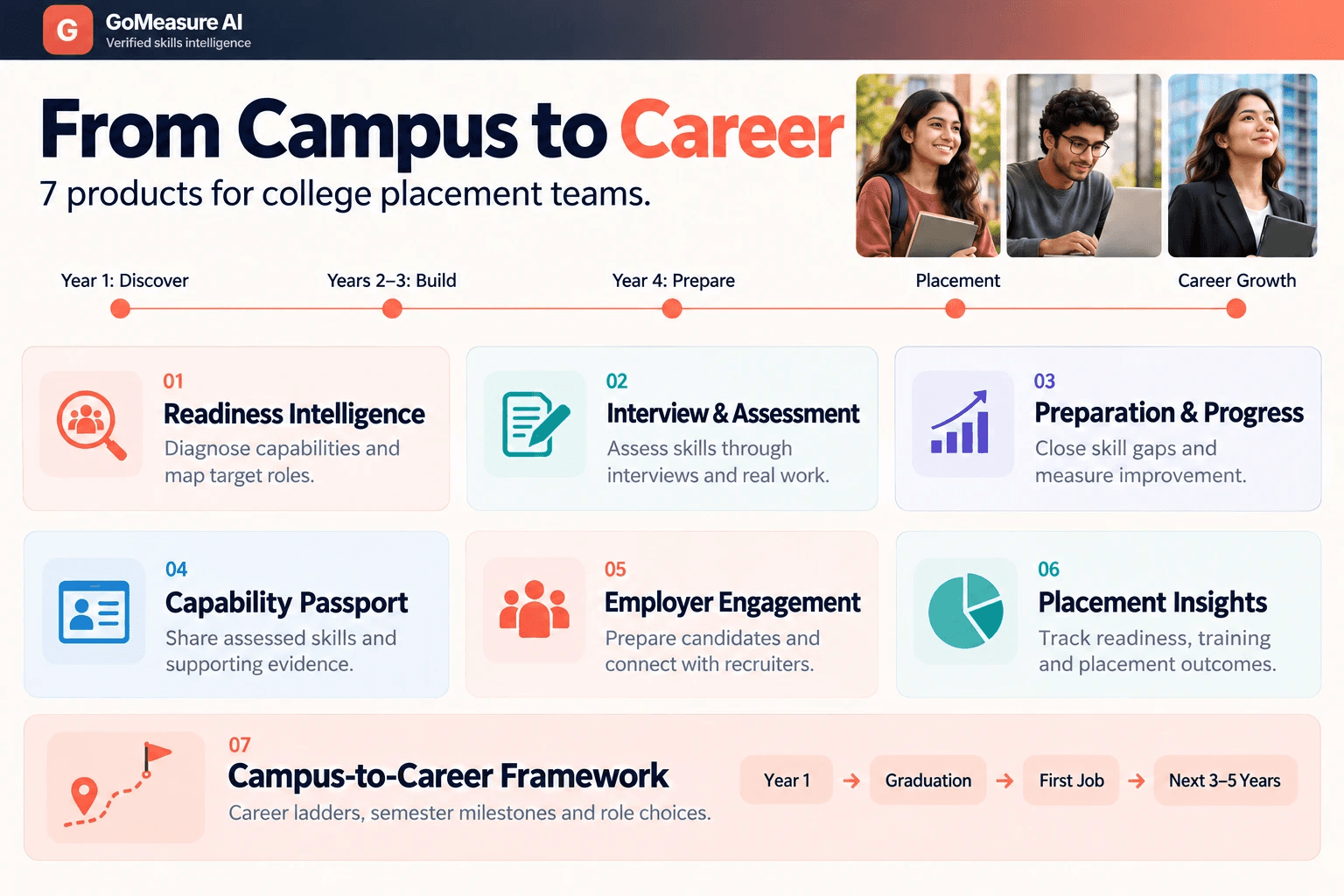
Batch diagnostics, student profiles, role mapping and readiness dashboards.
AI mock interviews, adaptive assessments, practical tasks and project evaluation.
Personalised plans, gap-based practice and reassessment to measure improvement.
Shareable profiles with assessed skills, work samples and supporting evidence.
Recruiter-specific preparation, evidence-based shortlists and candidate showcases.
Placement funnel analytics, training effectiveness and department-level gaps.
Career ladders from Year 1, semester skill milestones, graduate role choices and visibility into the first three to five years of professional growth.
Connect student development and placement decisions through a shared capability record.
Map courses, cohorts, target roles and the capabilities each role requires.
Establish a baseline through interviews, assessments and practical tasks.
Turn measured gaps into individual action plans and targeted practice.
Use comparable evaluations to check improvement and remaining gaps.
Build a talent passport with scores, work samples, dates and evidence.
Prepare employer-specific shortlists and talent showcases for TPO review.
Use several forms of evidence to build a more useful picture than a single test or interview can provide.
Role-specific questions, adaptive follow-ups and structured feedback for repeated practice.
Coding, case analysis, business writing, data interpretation and workplace simulations.
Scenario-based evaluation of judgment, collaboration and problem solving against defined rubrics.
Evaluate task framing, AI use, output verification, error detection and final decisions.
Bring relevant evidence together in a talent passport that students and TPOs can share with recruiters.
Keep claimed, measured and reviewed evidence distinguishable. Show assessment recency, relevant context and the student’s individual contribution.
Keep human review central to candidate selection and employer engagement.
Track outcomes against a defined baseline. Placement results also depend on employer demand, student choices and recruitment processes.
Weekly coordination. Faculty participation. Reviewed student work.
Start with one cohort. Agree the scope, run the journey, review the evidence — then expand with what you learn.
Modules, integrations, evaluation rules and delivery scope are agreed during pilot design. Student evidence sharing should follow institutional policies and appropriate consent.