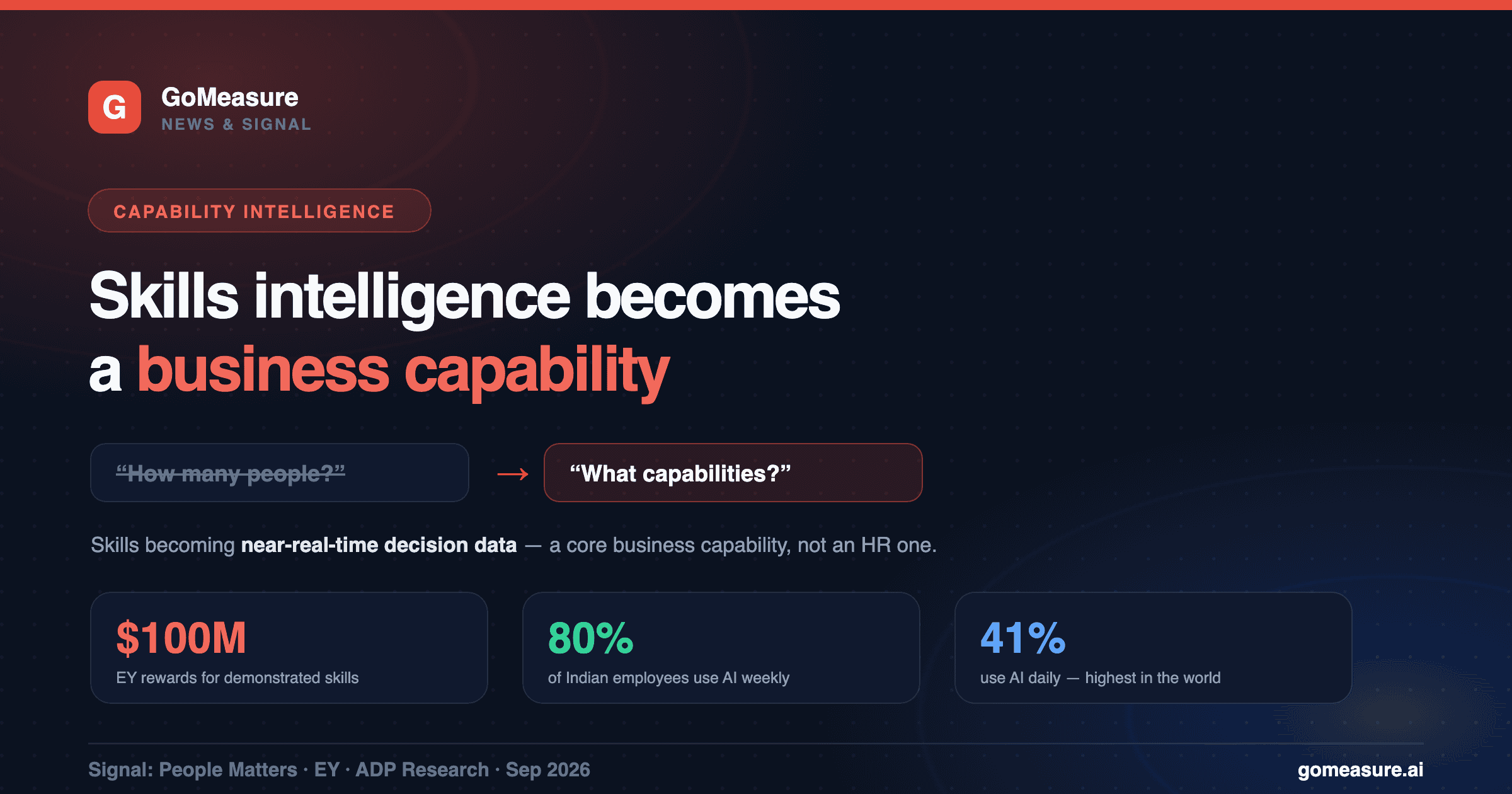
On 2 September 2026, People Matters reported that Bread Financial is integrating skills intelligence directly into workforce planning — not running it as a separate HR program. It keeps a comprehensive skills inventory, then uses that data across hiring, internal mobility, learning, succession and strategic workforce planning. The shift: from “How many people do we need?” to “What capabilities do we need?”
It wants skills to become near-real-time decision data — what capabilities exist now, what will be required, and which gaps need intervention — and expects skills intelligence to become a core business capability, not an HR capability, over the next several years.
Two signals reinforce it. EY announced a $100M program rewarding US staff for demonstrated future-focused skills, innovation and measurable impact (top awards $10,000–$25,000) — pay attached to demonstrated capability, not course completion. And ADP Research finds 80% of Indian employees use AI multiple times a week and 41% daily — the highest in the world (vs ~50% / 20% globally).
This is the real enterprise product: not an assessment platform, but a capability intelligence system that tells leadership what capabilities they actually have, how trustworthy the evidence is, what they’ll need in 12–24 months, who can move into future roles, who needs development, and whether learning actually changed capability.
The spine: skills inventory → verified capability → workforce decision → development → evidence of improvement → business impact. With AI use now a mass-workforce behaviour, verified AI capability + human judgment is an everyone problem — not a specialist one.
That’s what GoMeasure is: capability intelligence for the enterprise — evidence-graded answers to workforce decisions, with mobility, succession and planning wired to demonstrated, verified capability.