The skill that stops AI hallucinations reaching your customers
A hallucinated number in a client memo, a fabricated citation, a plausible-but-wrong assumption — AI errors are dangerous precisely because they look right. Verification is the capability that catches them before they ship. This explains it, its five levels, and how GoMeasure measures the AI Verification Quotient from demonstrated evidence discipline.
Read article →
If AI wrote it, what did the human add?
AI makes everyone's output look competent, which makes genuine human value harder to see — and easy to over- or under-credit. Human contribution is the capability of adding something the model wouldn't have: reframing, insight, high-value correction, ownership. This explains it, its five levels, and how GoMeasure measures the Human Contribution Quotient to support fairer talent decisions.
Read article →
When should you trust an AI output — and when should you override it?
Two failure modes waste AI: trusting it blindly, and checking everything it produces. The capability that avoids both is trust calibration — knowing when to accept, verify, challenge or override, matched to task risk. This explains calibrated AI trust, its five levels, and how GoMeasure measures the AI Trust Quotient from demonstrated behaviour.
Read article →
AI can draft the answer. Can your people make the call?
When AI can produce a confident recommendation in seconds, the bottleneck moves to judgement: weighing trade-offs, acting when evidence is incomplete, and owning the outcome even when the AI is wrong. This explains judgement as an AI-era capability, its five proficiency levels, and how GoMeasure measures the Judgment Quotient from demonstrated decisions rather than credentials.
Read article →
"Working with AI" isn't one skill — the five levels of AI-enabled work
Give two people the same AI tools and one triples their output while the other adds risk. 'Working with AI' is a capability that comes in levels — from basic tool use to designing repeatable AI-enabled operating models. This lays out the five levels of AI-enabled work, and how GoMeasure measures the AI Work Quotient from demonstrated tasks rather than tool familiarity.
Read article →
Can your team actually supervise AI? The oversight capability no one measures
When AI performs significant work, someone still has to supervise, verify, challenge and own the outcome. That capability — AI oversight — is what keeps automation accountable, yet almost no one measures it. This is what AI oversight means, its five proficiency levels, and how GoMeasure measures it (the AI Oversight Quotient) from demonstrated work so you can authorise AI use with confidence.
Read article →
Proving ROI from AI adoption: why pilots stall — and how to measure real value
Proving ROI is one of the hardest AI-era problems for HR and business leaders — Deloitte finds tech-focused AI approaches are 1.6× more likely to miss ROI expectations than human-centric ones. This is why AI pilots fail to show value, and how to measure it: establish pre-deployment baselines and track adoption, cycle time, work quality, risk and business outcomes — with the human capability underneath verified, not assumed.
Read article →
AI literacy isn't AI proficiency: the five levels of AI capability
An 'AI user' is not one person. Microsoft's data shows a wide spread between people who have merely tried AI and those redesigning work around it. This defines the five levels of AI capability — awareness, assisted user, proficient collaborator, workflow designer, AI supervisor — why course completion doesn't prove any of them, and how to measure the level someone is actually at from demonstrated work.
Read article →
Shadow AI: what to do about uncontrolled employee AI use
Shadow AI — employees using unsanctioned AI tools for real work — is far more common than leaders think; McKinsey found actual employee GenAI use several times higher than executives estimated. Here's the real risk (data leakage, unverified output, invisible overreliance), why bans backfire, and a practical response: approved tools, clear policy, workflow telemetry, risk classification and safe alternatives — with the capability underneath measured.
Read article →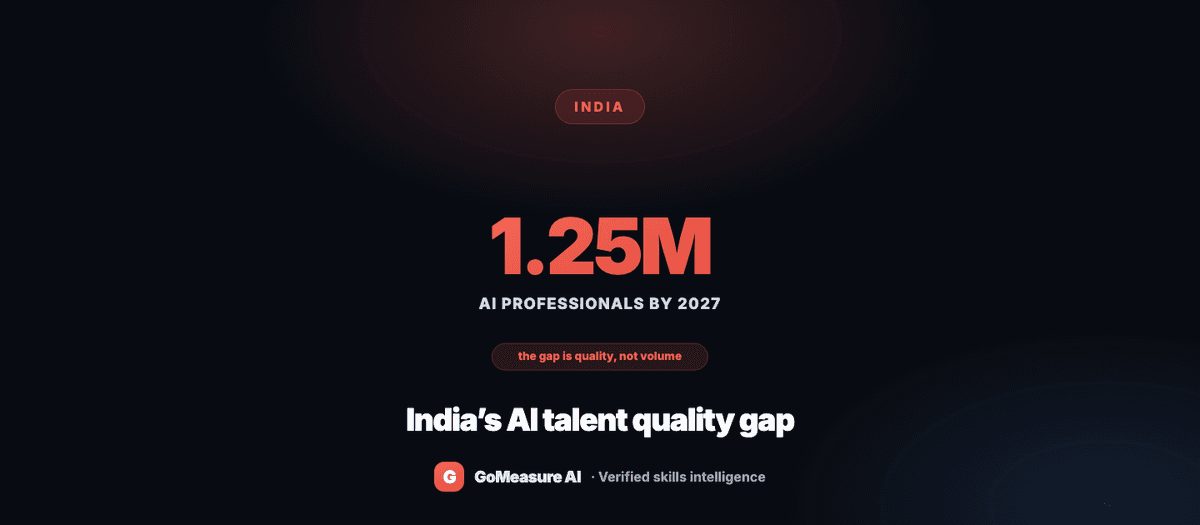
India's AI talent quality gap: volume isn't the problem, verified capability is
India's AI talent challenge is often framed as a shortage of people. The sharper problem is a quality and verification gap: with AI-assisted CVs, courses and portfolios, employers can't reliably tell applied AI capability plus domain judgement from polished signals. Deloitte-Nasscom projects demand above 1.25 million AI professionals by 2027. Here's why the gap is about verified capability — and how to close it with applied projects, role simulations and evidence portfolios.
Read article →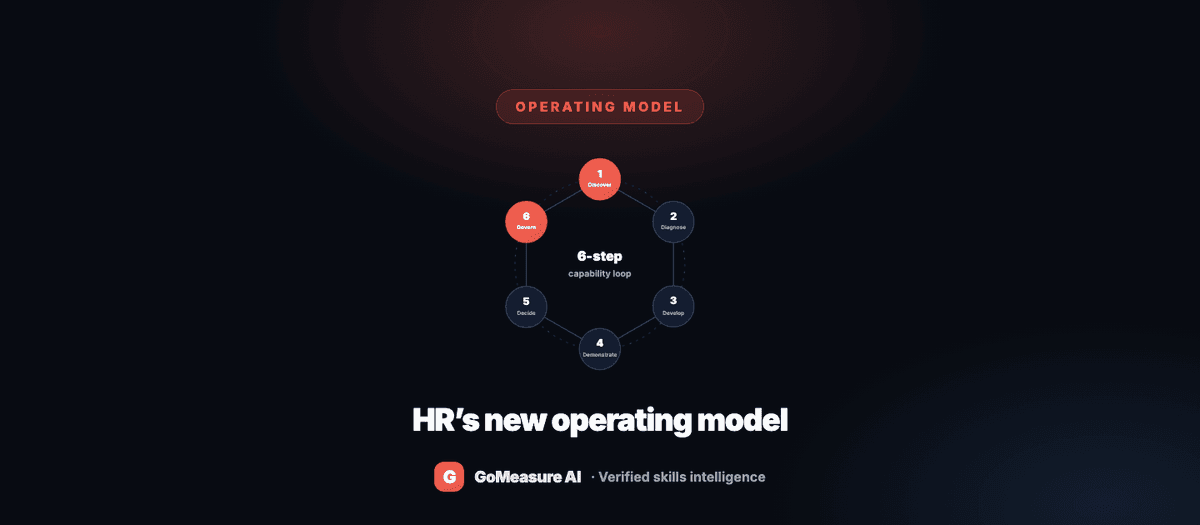
HR's operating model must change: from administrative records to capability intelligence
Every AI-era workforce challenge lands on HR — redesigning work, verifying skills, proving ROI, managing trust — yet Deloitte notes conventional HR is often too slow and siloed for multidisciplinary transformation. This is the case for changing HR's operating model itself: from administrative records and annual programs to continuous capability intelligence, built on a six-step architecture — Discover, Diagnose, Develop, Demonstrate, Decide, Govern.
Read article →
Distributed de-skilling: AI's real risk isn't one worker — it's the whole organisation
A new BCG study names the danger 'distributed de-skilling' — the collective erosion of judgement, problem-framing and reasoning across an organisation, not just in one employee. The unsettling finding: the capabilities leaders rate most important are the ones most exposed to AI. BCG offers six mitigation strategies — and every one of them assumes you can measure whether the human skill underneath is still real. Here's the report, and what it means for how you run your workforce.
Read article →
Hiring graduates on potential, not pedigree — the Human Quotient
Companies bet on graduates using the weakest signals they have — a GPA, a college brand, a 20-minute interview — all claims, all biased, and none of them answer the only question that matters for a fresher: what will they become? The Campus Human Quotient battery measures potential and fit instead of knowledge, across Capability (can they think and learn?), Disposition (how are they wired to behave?) and Alignment (will they fit and stay?). Here's why to give it, what to expect from the result, and how to interpret an HQ profile without over-reading it.
Read article →
A test, a role, a person: the three lenses for evaluating talent
You can't evaluate a person from one angle. Zoom all the way in and you see a moment — a single test, precise but a snapshot. Pull back and you see a role — a proven match between a person and a job. Pull back further and you see the whole human — capability, disposition and alignment together. Most talent mistakes are altitude errors: using one lens to answer another's question. The holistic view holds all three on one evidence spine, so they roll up instead of contradicting — and every level traces back to proof.
Read article →
Cognitive ability vs. aptitude: what these tests really measure (and what they don't)
Cognitive ability is your general thinking horsepower; an aptitude is that horsepower pointed at one specific thing — your potential to learn it. They blur together because aptitude tests are built out of cognitive-ability components. But neither measures a job skill: they measure the reasoning faculties that predict how fast someone will acquire skills. Put them on a ladder — ability → aptitude → skill → performance — and the confusion clears: the first two are potential, skill is proof, and confusing the rungs is where hiring and promotion go wrong.
Read article →
Role, competency, KRA, KPI — and the one layer you're missing
Role, competency, KRA and KPI define what good looks like — but nothing connects the competency a role needs to how much of it a person actually has. Competency lives on paper; the KPI, the only thing you measure, is a lagging signal. The missing layer is the measured skill: competencies broken into skills, measured on evidence to a level and a confidence, against what the role requires. It sits on top of the framework you already have — and it's what makes every hiring, mobility and development decision defensible.
Read article →
Performance vs. capability: why your best performer might have your weakest skills
Your top performer might be your weakest engineer — and your performance system can't tell. A result is inflated by territory, team, tenure and tailwind, so a high rating is consistent with high skill and with a favourable context. This is why context-inflated performance breaks exactly when you lean on it — promotion, succession, reorg — and how to separate capability from context by measuring skill on independent evidence.
Read article →
The hidden cost of not knowing what your people can do
Unreliable skills data doesn't show up as a cost on any report — so it never gets managed. But it's paid for continuously: hiring outside for skills you already have, transformations that stall in execution, training budget spent on gaps that weren't real, key-person risk, and mis-hires. This is where the cost of not knowing what your people can do actually lands, why it stays invisible, and what changes when capability is measured.
Read article →
Your board measures every risk but one — and it's the one your strategy runs on
Every strategy a board signs off is a bet that the workforce can execute it. Yet capability is the one input with no reliable data, no clear owner and no place on the risk register — even as skill gaps are now the single biggest barrier to transformation. This is the case for treating capability as a measured, board-level risk, why it has become acute, and what closing the blind spot actually requires.
Read article →
You have skills data. You just can't trust it.
Your CEO asks who's ready for the new market. A manager asks who can cover a critical role. You open the system — and hesitate, because you already know the skills data isn't reliable. This is the situation HR is quietly stuck in: asked to decide on skills, on data you can't stand behind. Here are the twelve reasons that data goes wrong, the three failures they cluster into, and what a skills system actually has to do to fix it.
Read article →
Inferred, tested, or proven: how to evaluate a skills tool before you buy
Shopping for skills intelligence, everything claims to be "verified" and "data-driven". Underneath, tools do one of three very different things: infer skills from data, test them with a fixed assessment, or prove them by demonstration. Each carries a different level of confidence — and a tool can measure real skills yet still measure the wrong ones. This is how to tell the three apart, the two axes that matter, and the questions to ask any vendor before you buy.
Read article →
Why an off-the-shelf skill assessment tests a role you don't have
Buying a ready-made skills assessment feels like real measurement — and it is. The problem is what it measures. A standard test is built for a standard role, but every company's version of that role has different must-have skills. So the test grades people on a generic set that only partly overlaps with what actually matters — and misses the skills you most needed to check. This is the assessment mismatch, in plain English, and what to do about it.
Read article →You've set the strategy. Do you have the skills to execute it?
Every system in the HR stack answers a narrower question — who works here, where they are in the pipeline, what they've studied, what they know. But none answers the one executives increasingly ask: do we have the capability to execute our business strategy? Tracing HR technology from HRIS to HRMS to HCM, this is why Skills Intelligence has emerged as its own strategic layer — and what makes it different from a feature bolted onto the systems you already run.
Read article →
“I already have skills in SuccessFactors — why do I need you?”
If your HRMS — SuccessFactors, Zoho People, Oracle, JD Edwards — already holds a skill matrix and skill ratings, why add another tool? Because storing a skill is not the same as proving it. This is the plain-English difference between a system that records what people say they can do and one that checks whether it's true — and why the two work together, not against each other.
Read article →
Performance and skills: why your organisation needs both — and what each one actually does
Performance tells you what someone delivered. Skill tells you what they can actually do. They are not the same thing — a strong result can come from a strong team or an easy territory, and a strong skill can sit behind weak results because of poor role fit. This is why an organisation needs both, what each one is for, and why performance, skill, potential and readiness must be kept as four separate objects rather than collapsed into one rating.
Read article →
The skills-mapping problem: why skills-based transformation stalls before it starts
Skill gaps are now the number-one barrier to business transformation — but you cannot close a gap you cannot see, and most organisations cannot see theirs because the skills map is wrong, fragmented, or already stale. This is why skills mapping is the real bottleneck of becoming skills-based, the six ways it breaks, why the usual fixes fail, and what a map that survives contact with reality looks like.
Read article →
The 2% problem: how a company actually becomes skills-based
Nearly every organisation says it is becoming skills-based. Almost none have arrived. The gap isn't ambition or software — it's that a skills programme built on claims collapses the moment a real decision rests on it. A five-move playbook for transforming on proof, not inventory.
Read article →
Cognitive debt: AI is eroding the skills you can no longer see
As teams offload memory, analysis and judgement to AI, research from BCG, MIT and Deloitte points to a growing 'cognitive debt' — critical thinking atrophies, decisions get made on autopilot, and professional confidence erodes. The unsettling part: it happens silently, in the flow of work. Which is exactly why measuring the human matters more in the AI era, not less.
Read article →
The best way to measure a skill is changing — into the flow of work
For a century, measuring a skill meant one thing: give someone a test. That's changing. The best measurement is no longer a single method at a single moment — it's a layered, continuous read that increasingly reaches into the work people already do. Here's the spectrum of methods, why in-flow measurement is the frontier, and what it takes to do it honestly.
Read article →
Taxonomy, ontology, and why a skills list is not a skills model
Most skills-based efforts start and stop at a taxonomy — a big list of skill names. It's necessary, but a list of words is not a model. What turns a taxonomy into something you can actually measure against is an ontology: the structure, levels, relationships and evidence rules underneath the names.
Read article →
The rise of work evidence tools: why the future needs an Evidence Engine
Most organisations want to be skills-based, but their skill decisions still rest on incomplete signals — claims, tests, and activity. The missing layer is validated work evidence, and the missing product is an Evidence Engine: a system that decides what a signal actually proves, records it in an auditable ledger, and turns it into a Skill Passport and Capability Trust.
Read article →
The future of assessment: from the test before the job to proof from the work
A test before the job is a snapshot that goes stale the moment work begins. The next era of assessment measures skill from the work people already do — turning everyday activity into validated, current proof. Here is what changes, and the one word that separates it from surveillance.
Read article →
Not all skills prove the same way: the four evidence shapes
The uncomfortable truth of assessment science is that proof is not one thing. Different skills demand different shapes of evidence — and the reason negotiation is so much harder to verify than objection-handling tells you almost everything about how to build a skill proof that holds up.
Read article →
How adaptive interviews actually work: CAT, IRT and evidence-anchored scoring
An adaptive AI interview is not a chatbot with a question list. It is a measurement instrument: computerized adaptive testing chooses each question by information gain, item-response theory estimates true ability with a confidence bound, and every score is anchored to the exact answer that earned it.
Read article →
Verified, inferred, or proven: why the résumé is breaking in the AI era
The résumé was already a weak signal. Generative AI has broken it completely. This is the difference between inferring a skill, testing for it, and proving it — and why only the last one holds up when a hiring decision is challenged.
Read article →