
It's a fair question
If you run SuccessFactors — or Zoho People, Oracle, JD Edwards, any of the big HR systems — you already have a place for skills. There's a skill matrix. Every role has skill sets. Employees have proficiency levels next to their names. So when someone suggests another skills tool, the honest reaction is: why? I already have all of this.
You're right that you have it. The question worth asking is a different one: is it true? And that one small word is the whole difference between what your HR system does and what GoMeasure does.
Think of a driving test
Imagine two ways of knowing whether someone can drive.
The first: they fill in a form that says "Yes, I can drive — I'd rate myself 8 out of 10." The second: they take a driving test with an examiner, on the road, and pass.
Both end up as a record that says "can drive." But only one of them is proof. You would happily hand car keys to the person who passed the test. You would be nervous handing them to the person who just ticked a box about themselves.
Your HR system is the form. It records what people say. GoMeasure is the driving test. It checks whether it's actually true.
That's the entire idea. Everything below is just detail on it.
Where do those skill ratings actually come from?
Here's the part most people never stop to think about. Open your HR system and look at any skill rating — "Python, Level 4", "Negotiation, Advanced", whatever it is. Now ask: who decided that, and how?
Almost always, it came from one of three places:
- The employee rated themselves — during a review, ticking their own boxes.
- Their manager rated them — often quickly, from memory, months ago.
- The software guessed — suggesting skills based on someone's job title.
Notice what all three have in common: nobody actually checked. They're opinions and guesses, neatly stored in a tidy grid. Your skill matrix looks complete and organised — but underneath, it's mostly people's claims about themselves. It looks like data. It's really a pile of "trust me."
Recording is not the same as proving
None of this means your HR system is bad. It's excellent at what it was built for: storing information, running your review cycles, keeping org charts and workflows tidy. It's the filing cabinet for your whole HR operation, and you should absolutely keep it.
But a filing cabinet doesn't check whether the things filed inside it are true. That was never its job. Storing a skill and proving a skill are two completely different tasks — and your HR system only does the first one.
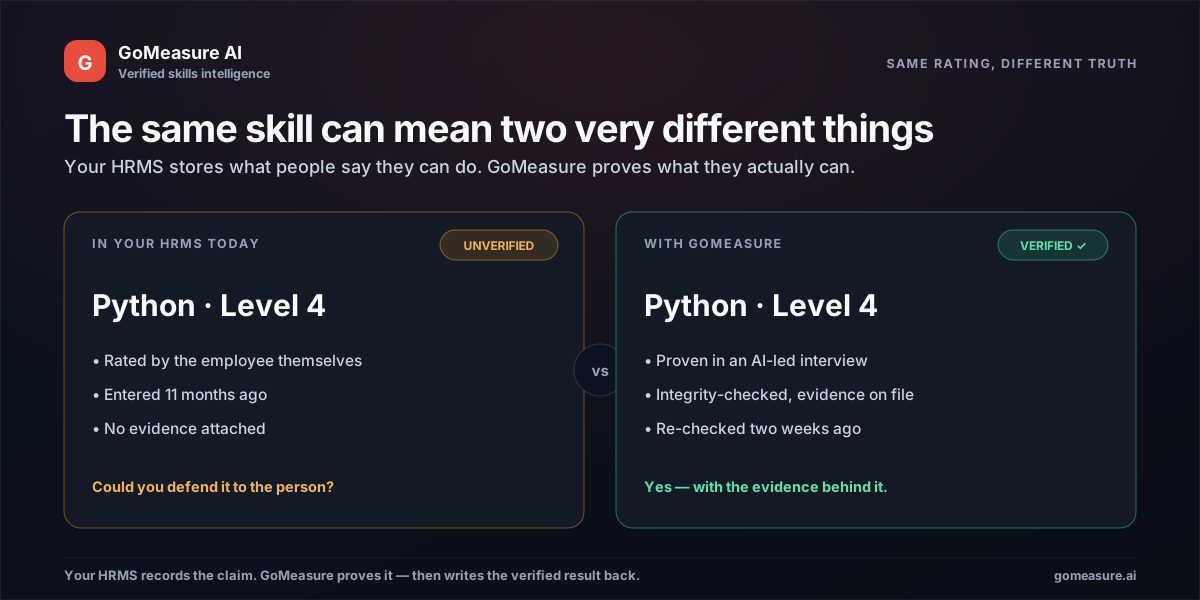
Here is the same thing, point by point:
Every row is the same story: your system holds the label. It doesn't hold the truth behind the label. And when you make real decisions — who to promote, move, develop, keep — you're betting on labels that were never checked.
You don't replace your HR system. You make it honest.
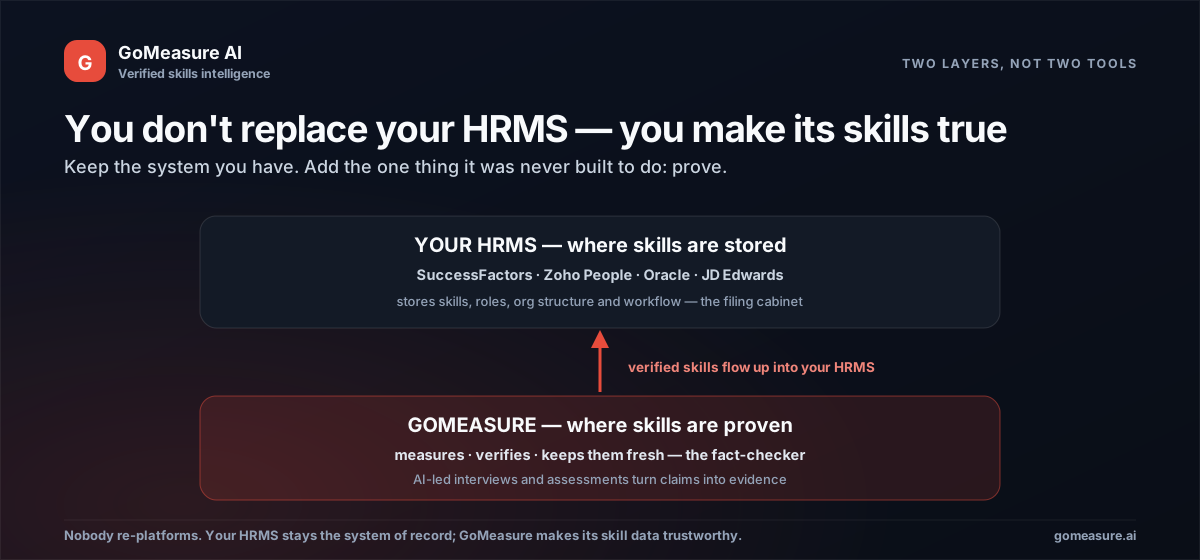
Here's the part that usually settles the "why do I need another tool" worry: you don't rip anything out. Nobody re-platforms. You keep SuccessFactors (or Zoho, or Oracle) exactly where it is, doing exactly what it's good at.
GoMeasure sits underneath it as the checking layer. It runs the "driving test" — a short, AI-led interview or assessment that actually measures a skill — and then writes the verified result straight back into your HR system. The grid you already have stays. The numbers in it become true.
What actually changes for you
When the ratings are proven instead of guessed, ordinary decisions get better — and safer:
- Gap reports you can trust. You spend training budget on real gaps, not gaps that only existed because someone rated themselves too low (or too high).
- Fill roles from inside with confidence. When the system says someone can already do the job, they actually can — so you hire from within instead of paying to recruit outside.
- Succession you can defend. "Ready for the next role" means proven-ready, not a manager's hunch — the kind of decision that holds up when it's questioned.
- Fewer expensive mistakes. No more promoting the confident self-rater over the quiet person who's genuinely better.
The short version
- Your HR system stores skills. It doesn't check whether they're real — the ratings are mostly self-assessments, manager guesses, or software suggestions.
- Storing a skill and proving a skill are two different jobs. Your HRMS does the first; it was never built for the second.
- It's the difference between a form that says “I can drive” and a driving test that proves it.
- GoMeasure doesn't replace your HR system — it's the checking layer that proves each skill and writes the verified result back in.
- Proven ratings mean training, hiring, mobility and succession decisions you can actually trust and defend.
Keep SuccessFactors. Make its skills true.
Let us take one role you care about and show you the difference between the skill ratings you have today and skill ratings that are actually proven — written straight back into the system you already use. No re-platforming, no rip-and-replace.
See it on one of your roles How the Skills Graph works →The whitepaper, the playbooks and new research — by email.
Skills intelligence for HR and business leaders. We'll send the “Jobs to Skills” whitepaper and share new frameworks as we publish them. No noise.
One email now, occasional research later. Unsubscribe anytime.