
The moment you know the data won't hold
Your CEO asks a simple question: do we have the people to launch in the new region? A manager needs to cover a critical role next month and asks who's ready. Finance wants to know if the training budget actually worked.
Every one of these is a skills question, and you're the one expected to answer. So you open the system where all the skills live — the profiles, the matrix, the ratings — and you feel it: a small hesitation. Because you already know, without saying it out loud, that the data in there isn't quite real. Some of it is years old. Some is people rating themselves. Some is scattered across five systems that don't talk. You give an answer anyway — and it's really a guess, dressed up as data.
That's the quiet bind HR is in. Not a lack of skills data — most organisations have plenty. A lack of trustworthy skills data. And you can't manage what you can't trust.
Twelve reasons the data goes wrong
The problems aren't random. Every reason skills data becomes unreliable falls into one of three failures — it's out of date, it's unverified, or it's disconnected — and all three end in the same place.
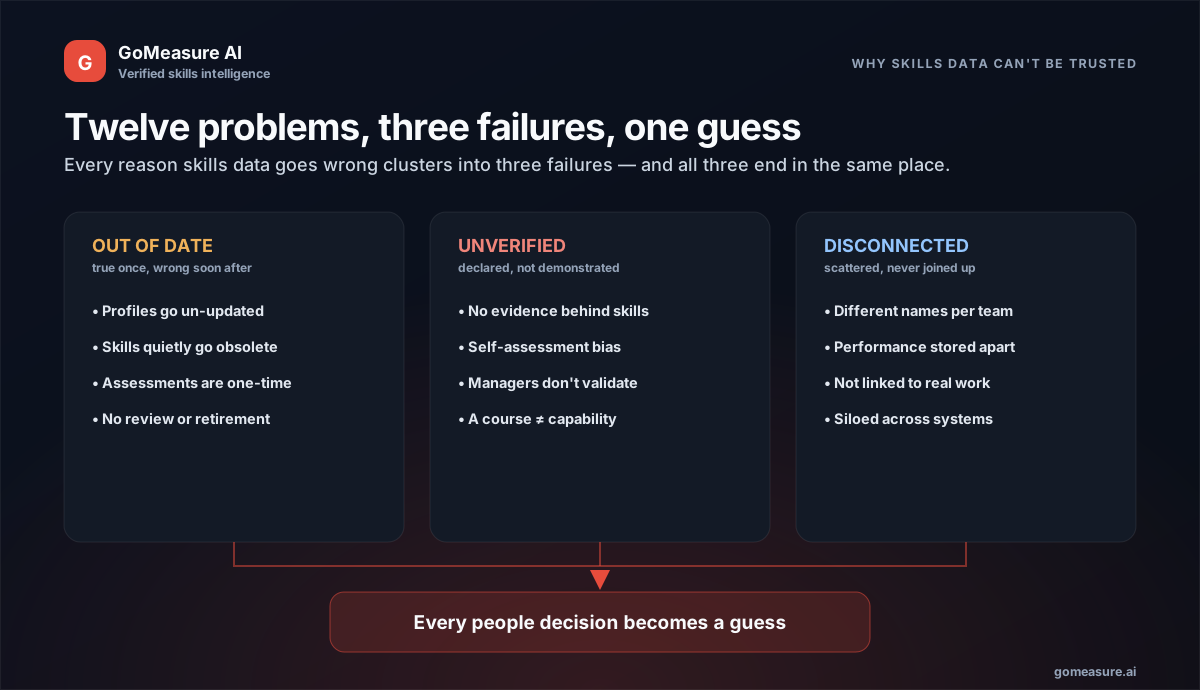
Failure 1 — Out of date: true once, wrong soon after
Skills data is a snapshot of a moving subject, and nothing keeps the snapshot fresh.
Failure 2 — Unverified: declared, not demonstrated
Most of what's in the system is someone's claim about a skill, not proof of it.
Failure 3 — Disconnected: scattered, never joined up
The pieces that would make skills data meaningful sit in different systems that don't speak to each other.
Why this quietly breaks HR's job
Any single one of these is survivable. Together, they mean the skills data underneath your decisions is stale, self-reported and fragmented — and every decision inherits that. The uncertainty doesn't announce itself; it just shows up as outcomes you can't fully explain:
- You promote the confident self-rater over the quieter person who was actually stronger.
- You recruit externally for a skill three people already have — because the system couldn't see it.
- You build a succession plan on readiness scores nobody can defend.
- You spend training budget on gaps that were never real, and miss the ones that were.
None of these feel like a data problem in the moment. They feel like bad luck, or bad judgement. But the judgement was fine — it was working from a picture of the workforce that wasn't true.
What's missing — and what a real skills system has to do
Notice that none of the twelve problems is solved by collecting more skills data. They're solved by changing what the data is. The three failures point directly at the three things a skills system actually has to do — the things your current stack was never built for:
- Stay current. Skills have to be re-verified on a policy as they change, so the picture is live — not a profile someone filled in two years ago and never touched again. This fixes out of date.
- Be evidence-based. A skill should be proven by demonstration, not declared by the person who has it or guessed by a manager. Evidence is what turns "I think so" into "here's how I know." This fixes unverified.
- Be connected. One shared skills language, mapped to real work and joined up across your HR, learning, hiring and performance systems — so capability is one picture, not five fragments. This fixes disconnected.
That combination — current, evidenced, connected — is what a Skills Intelligence layer is for. It doesn't replace the systems you have; it makes the skills data inside them something you'd actually bet a decision on. (Which is why a skill matrix in your HRMS isn't the same as verified skills.)
The short version
- HR isn't short of skills data — it's short of skills data it can trust, which is worse, because decisions get made on it anyway.
- Twelve common problems all cluster into three failures: the data is out of date, unverified, or disconnected.
- The result is that people decisions — promotion, hiring, succession, training spend — quietly become guesses.
- The failures don't feel like data problems; they show up as outcomes you can't explain.
- The fix isn't more data. It's skills data that stays current, is proven by evidence, and is connected across your systems.
Answer “who can do what?” with confidence.
GoMeasure gives HR skills data it can actually trust — verified by evidence, kept current, and connected across your systems. So the next time you're asked who's ready, the answer is a fact, not a hope. Start with one team and see the difference.
See Skill Proof in Action How the Skills Graph works →The whitepaper, the playbooks and new research — by email.
Skills intelligence for HR and business leaders. We'll send the “Jobs to Skills” whitepaper and share new frameworks as we publish them. No noise.
One email now, occasional research later. Unsubscribe anytime.