
Everyone argues about measurement. The map is the real bottleneck.
Ask a room of HR leaders what is hard about becoming skills-based and most will say measurement — how do we assess skills reliably, at scale, without it taking forever? It is a fair question. But it is the second question. The first, and the one that quietly kills more transformations, is simpler and nastier: what are the skills, and who has them? That is the mapping problem, and it is where skills-based programmes stall before measurement is ever reached.
The stakes are not abstract. In the WEF Future of Jobs Report 2025, 63% of employers name skill gaps as the single biggest barrier to business transformation over the next five years, and expect 39% of workers' core skills to change by 2030. You cannot close a gap you cannot see — and you cannot see it without a map of what skills you have and need. Yet by one industry estimate, only about 45% of companies have even a basic skills library, the most preliminary version of a map.
So the picture is stark: near-universal urgency, a moving target, and most organisations without a usable map. This is the skills-mapping problem — and it is worth understanding exactly how it breaks.
Why the map is the thing everything else stands on
A skills map is not a deliverable that sits beside your talent processes. It is the substrate underneath them. Hiring shortlists, internal-mobility matches, succession benches and learning plans are all queries against the map. If the map is wrong — wrong granularity, wrong names, stale data, unverified ratings — every decision built on it inherits that error, silently, at scale.
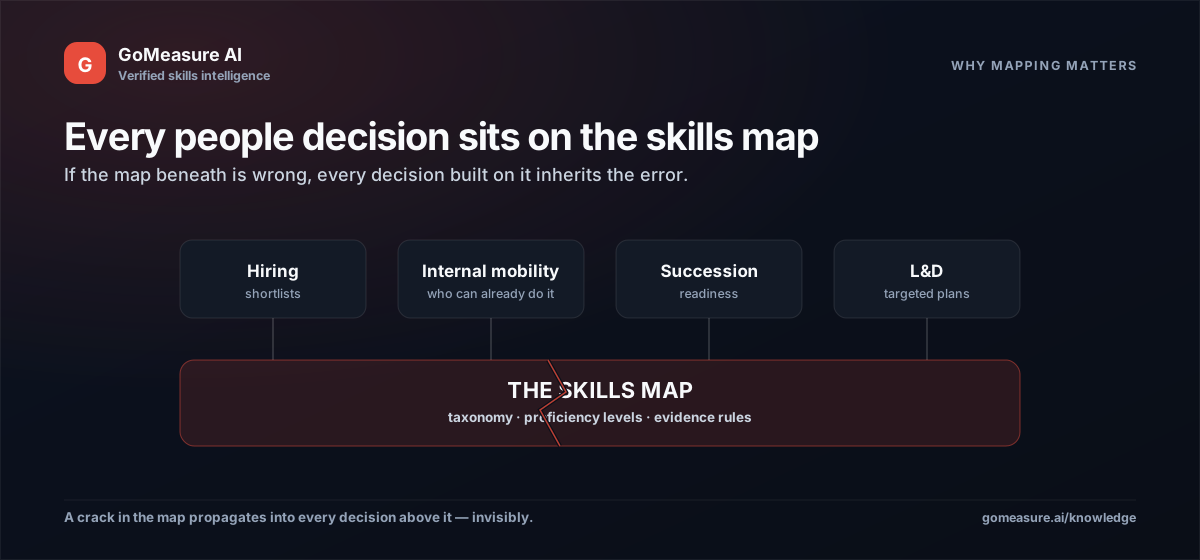
This is why mapping deserves more attention than it gets. Measurement errors affect one assessment. Mapping errors affect the foundation every assessment and decision rests on. Get the map wrong and you have built a skills-based organisation on sand — one that looks modern in a demo and makes worse decisions than the job-based model it replaced, now dressed up with the false confidence of data.
The six ways skills mapping breaks
Drawing on practitioner accounts of failed and stalled programmes, the same failure modes recur. Each is survivable alone; in combination they are why so few maps are ever trusted enough to decide on.
The decay trap: your map is wrong the day you finish it
Of the six, staleness is the one most people underestimate — because it doesn't announce itself. A skills map is a snapshot of a moving subject. And the subject is moving faster than ever: the half-life of a professional skill has fallen from roughly 10–15 years a generation ago to under five years today, and in fast-moving technical fields like AI and data, closer to two.
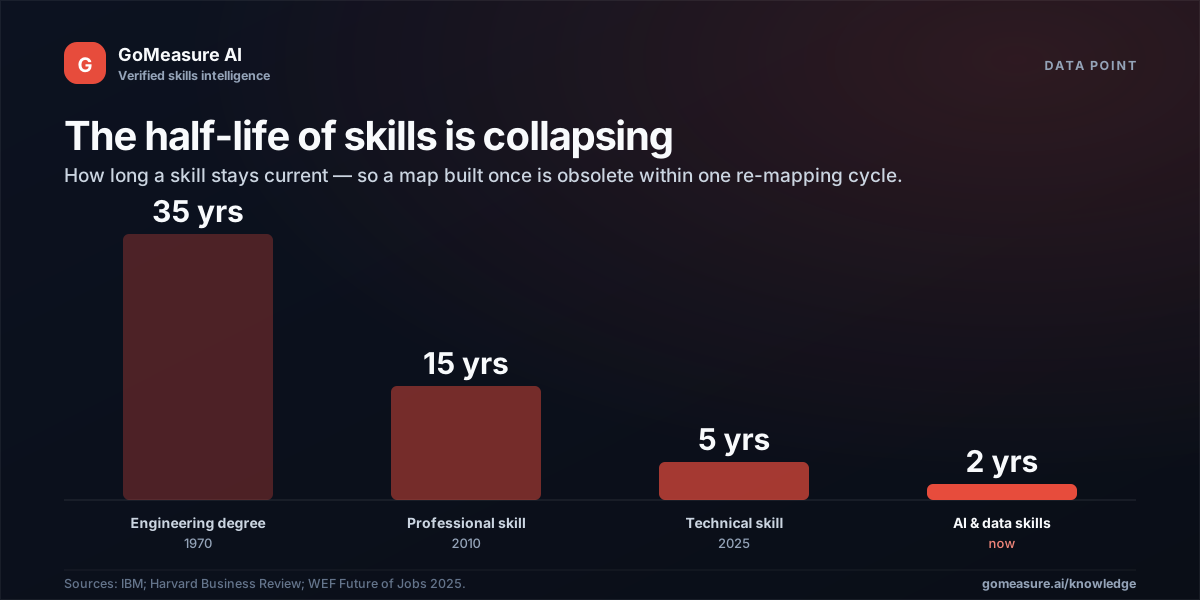
The implication is fatal for the way most organisations map. If you run a big one-time mapping exercise, the map begins decaying the moment it's finished — and because manual mapping is so painful, nobody wants to repeat it. So the map is never refreshed, trust erodes, and within a couple of years it is actively misleading. A map is not a document you complete. It is a system you keep true.
Why the usual fixes fail
Faced with the mapping problem, leaders reach for three fixes. Each is reasonable, and each addresses the wrong part of the problem.
The common thread: all three treat mapping as a data-collection exercise — get names into a taxonomy, get ratings into fields. But the map's value doesn't come from being complete. It comes from being right, current and evidenced exactly where a decision depends on it. That reframing is the whole solution.
What a map that survives contact with reality looks like
A skills map you can actually decide on has four properties the usual fixes miss:
- Scoped to decisions, not to everything. Map deeply the skills a real decision turns on — typically eight to twenty per role — rather than shallowly mapping thousands. Start from the decision and the scope defines itself.
- Modelled, not just named. Each mapped skill carries proficiency levels and evidence rules — an ontology, not a taxonomy. A skill without a definition of "good" and a way to prove it is a label, not a measure.
- Evidence-linked, not self-declared. Every rating on the map traces to validated evidence, so it holds up when challenged. This is the difference between inferring a skill and proving it — and different skills need different shapes of evidence.
- Living, not snapshotted. The map is re-verified on a freshness policy, so decay is managed rather than ignored. AI-assisted extraction and verification make continuous mapping feasible where manual mapping never was.
None of this requires mapping the whole enterprise before you begin. It requires mapping one decision's worth of skills properly — scoped, modelled, evidenced and kept current — then repeating. That is the argument of our companion pieces on becoming skills-based and the jobs-to-skills framework: the map is built one proven loop at a time, not in one heroic project.
Key takeaways
- Skills mapping — not measurement — is the real bottleneck of becoming skills-based; 63% of employers call skill gaps their biggest barrier, but most can't see their gaps because the map is missing or wrong.
- The map is the foundation every people decision stands on; a flaw in it propagates into hiring, mobility, succession and L&D invisibly.
- Mapping breaks in six recurring ways: wrong granularity, fragmentation, staleness, unverified data, manual effort, and no link to evidence.
- Collapsing skill half-lives (under five years, ~two in AI/data) mean any one-time map is obsolete within a re-mapping cycle — a map is a system you keep true, not a document you finish.
- The usual fixes — buy a taxonomy, run one big project, survey everyone — all treat mapping as data collection; what works is a map scoped to decisions, modelled, evidence-linked and living.
Stop drawing maps you can't trust.
GoMeasure builds a living, evidence-linked skills map: a skills graph modelled with levels and evidence rules, populated by AI-led verification rather than self-report, and re-verified so it stays true as skills decay. Scoped to the decisions that matter — so you get a map you'd actually bet a hiring, mobility or succession call on.
See Skill Proof in Action Explore the Skills Graph →The whitepaper, the playbooks and new research — by email.
Skills intelligence for HR and business leaders. We'll send the “Jobs to Skills” whitepaper and share new frameworks as we publish them. No noise.
One email now, occasional research later. Unsubscribe anytime.