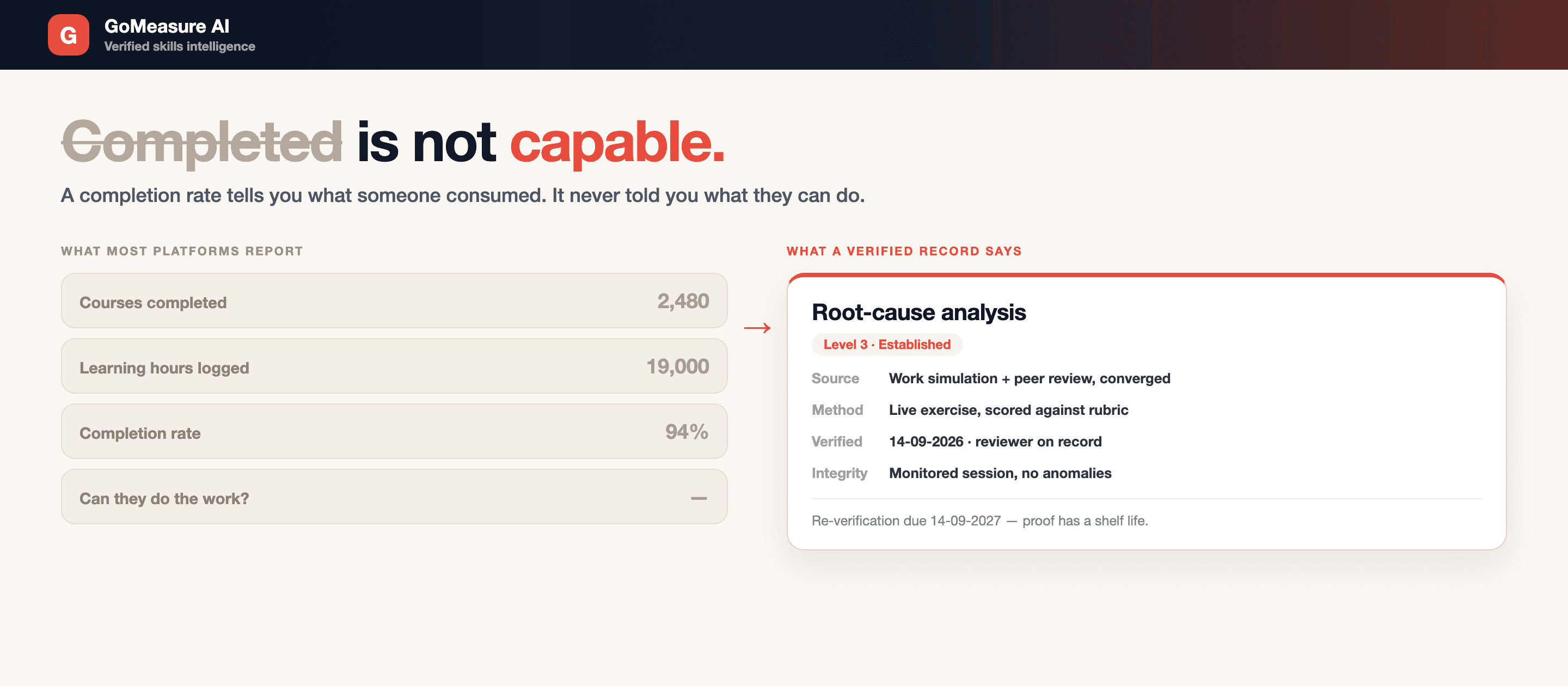
The metric that stopped meaning anything
Open any workforce development dashboard and you will find the same numbers: courses completed, hours logged, modules consumed, a learner satisfaction score somewhere in the corner. Every one of them measures the same thing — consumption. None of them answers the question a business actually has, which is whether the person can now do the work.
This was always a weak proxy. In a workforce where a growing share of the work happens alongside AI agents, it has stopped being a proxy at all. Someone can complete every module in an AI programme and still freeze the first time a model confidently returns something wrong. Someone else can have completed nothing and be quietly running half their role through agents, well. The completion rate cannot tell these two people apart, and they are the two people you most need to tell apart.
Consumption is easy to measure, which is why everyone measures it. Capability is hard to measure, which is why it is worth something.
GoMeasure is built around the harder question. Here is how the platform actually answers it, feature by feature — including, at the end, an honest account of which parts are proven and which are still early.
An agent fleet, not a portal
The old model puts learning and assessment in a destination: a portal people visit, a test they sit, a course they enrol in. The destination is the problem. People do not go to it, and when they do, what happens there bears little resemblance to their job.
GoMeasure runs instead as a fleet of agents, each owning one part of the loop and each doing work that used to need a person:
- Assessment Agent — adaptive assessment across skill, cognitive, personality and leadership, plus coding exercises, work simulations and language measurement. Adaptive means the test shapes itself to the person as it runs, so you learn more from fewer items.
- Interview Agent — live, recorded and asynchronous AI interviews that probe reasoning rather than recall, and score against evidence rather than impression.
- Integrity Agent — the verification layer. Proctoring, identity and anomaly signals, so a result means what it claims to mean.
- Coaching Agent — persistent, individual coaching against a person's actual measured gaps, with re-verification built into the end of it.
- Learn Agent — an AI course builder that takes a brief, proposes an outline, builds the material and routes it for human review, then re-measures afterwards to produce proof of learning rather than proof of attendance.
- Hiring & Workforce Agent — the decision layer: hiring, succession, internal mobility and workforce planning, all reading the same record.
- Skill & Career Framework Agent — the structural layer underneath: job architecture, competency frameworks, career paths.
- HR Copilot — ask your organisation a question in plain language, get a proposal, confirm it, and have it executed. The workflow comes to the person rather than the person going to a portal.
The point of a fleet rather than a feature list is that the agents share one record. What the Assessment Agent measures, the Coaching Agent works on and the Hiring Agent decides with. Nothing is re-keyed between systems, and nothing is lost in translation between a learning platform and a talent system that have never spoken to each other.
Content that writes itself to the role
The slowest part of traditional L&D is authoring. A role changes, and the curriculum catches up two quarters later — if someone remembers to ask for it.
The Learn Agent compresses that to a working session. A brief becomes an outline, the outline becomes built material, and a human reviews before anything publishes. The same applies on the measurement side: assessments and items can be drafted against a role, a job description or a competency, then reviewed and banked rather than written from a blank page.
A skill map that moves when the role moves
Most skills taxonomies are a one-time consulting deliverable that is out of date before it is signed off. The useful version is structural and live.
Underneath the platform sits a skills graph of roughly thirty-four thousand skills, tied to a job architecture: roles, levels, competencies and the required skills for each. A job description resolves against it. A career path is a route through it. A succession shortlist is a query on it. When a role changes — and in AI-era roles they change constantly — the required skills change with it, and every person mapped to that role immediately has a different gap profile without anyone rebuilding a spreadsheet.
This is what makes development targeted rather than generic. A gap is not "needs upskilling in data." It is a named skill, at a named level, against a named role, with the distance between the two measured.
AI fluency, measured rather than assumed
Every organisation now wants to know how AI-capable its workforce is. Most answer it with a usage statistic — licences issued, prompts sent, tools adopted — which tells you about activity, not about judgement.
Activity is the easy half. The hard half is whether someone can tell when a model is wrong, knows what to do when it is, and understands which parts of their work should not be delegated to it. We measure that directly, through dedicated batteries for AI readiness, AI adoption and AI-era capability, built around oversight and judgement rather than tool familiarity.
The distinction matters because the two can move in opposite directions. Heavy AI usage with weak oversight is not maturity — it is exposure, and the usage dashboard will show it as a success right up until something goes wrong in public.
The loop that actually closes
Measurement that happens once is a snapshot, and a snapshot ages badly. The platform runs a loop instead.
Two things make the loop more than a diagram. First, a verified skill carries an expiry — proof has a date, and a date eventually makes it stale, so the system knows when a claim needs re-establishing rather than assuming it holds forever. Second, when several sources say something about the same skill — an assessment, an interview, a work sample, a peer review — they are reconciled into one signal rather than stacked as four unrelated scores, and agreement between independent sources counts for more than any single result.
Evidence from many angles
The reason to run several methods is not thoroughness for its own sake. It is that every single method has a known failure mode. Tests reward test-takers. Interviews reward the articulate. Manager ratings carry the manager's biases. Self-assessment carries the Dunning-Kruger curve in both directions.
So the platform measures from several angles and converges them: adaptive assessments, AI interviews, coding and work simulations, 360° feedback, and — this is the part that makes it defensible — integrity signals that tell you whether the result was produced under conditions worth trusting.
Enterprise reality
None of the above survives contact with a real enterprise unless the unglamorous parts are solid. Multi-tenant isolation so one customer's data cannot reach another's. Entitlements so modules can be switched on per organisation rather than sold as one indivisible suite. Full organisation backup, restore and purge, because data you cannot delete on request is a liability. And a compliance posture — GDPR, India's DPDP, CERT-In, CMMI level 3 — that a security review can actually be pointed at.
The platform can also publish content beyond a single organisation's walls: a parent entity can make assessments or programmes available to subsidiaries, partners or a supply chain, with visibility and entitlement controlled centrally rather than by copying content into separate accounts.
Starting before the first job
The last piece is the one most workforce platforms never attempt, because the commercial logic is harder: the capability record should not start on someone's first day.
GoMeasure Campus takes the same measurement layer to colleges and placement teams, with a catalogue of entry-level role tracks, a readiness picture by student and cohort, and a journey that begins in the first semester rather than the final one. A student who learns in their third semester that communication is the thing holding them back has two and a half years to act. The same finding in their final September gives them eight weeks. It is the same argument as the rest of this piece, moved three years earlier.
What is proven, and what is early
An honest product post has this section, so here it is.
Proven and in production: the assessment and interview agents, integrity and proctoring, the skills graph and job architecture, the hiring, mobility and succession decision layer, coaching, the AI-era capability batteries, the course builder, multi-tenant delivery and the compliance posture. This is the measured bulk of the platform, running on real volume with real customers.
Early access: the Evidence Engine — capability inferred from real work signals rather than from a test. The foundations are shipped (evidence-anchored scoring, a provenance ledger, skill attribution) and the first connectors are live in pilot, but the full picture of a workforce measured continuously from its own work is in progress, not delivered. We say so on the page, and we would rather be believed later than overclaim now.
What we deliberately do not do: infer skills from a profile and present the inference as a finding. A guess dressed as a measurement is worse than no measurement, because people make irreversible decisions about other people's careers on it.
The question to hold any platform to
Whatever you buy — ours or anyone else's — one question separates the categories: can a person outside the system check a claim it makes?
If the answer is a score with no provenance, you have bought a dashboard. If the answer is a skill you can trace to its source, its method and its date, you have bought evidence. Only one of those is still worth something the day someone disagrees with it.
If you want to see where your organisation currently sits, the Skills Readiness Diagnostic takes about five minutes. The Proof Engine explains how the verification itself works, the skills graph covers the structural layer, and GoMeasure Campus is the version of all this that starts in the first semester.
The whitepaper, the playbooks and new research — by email.
Skills intelligence for HR and business leaders. We'll send the “Jobs to Skills” whitepaper and share new frameworks as we publish them. No noise.
One email now, occasional research later. Unsubscribe anytime.