Everything happens in the last semester
Ask a placement cell what their system does and you will hear about the season: drives scheduled, eligibility filtered, students shortlisted, offers tracked. Ask a student what their system does and you will hear about the same eight weeks from the other side: a profile filled in, a test sat, an interview survived.
Both answers are about Year 4. That is the strange thing about campus technology — an industry built around a four-year commitment concentrates almost all of its measurement into the final few months of it.
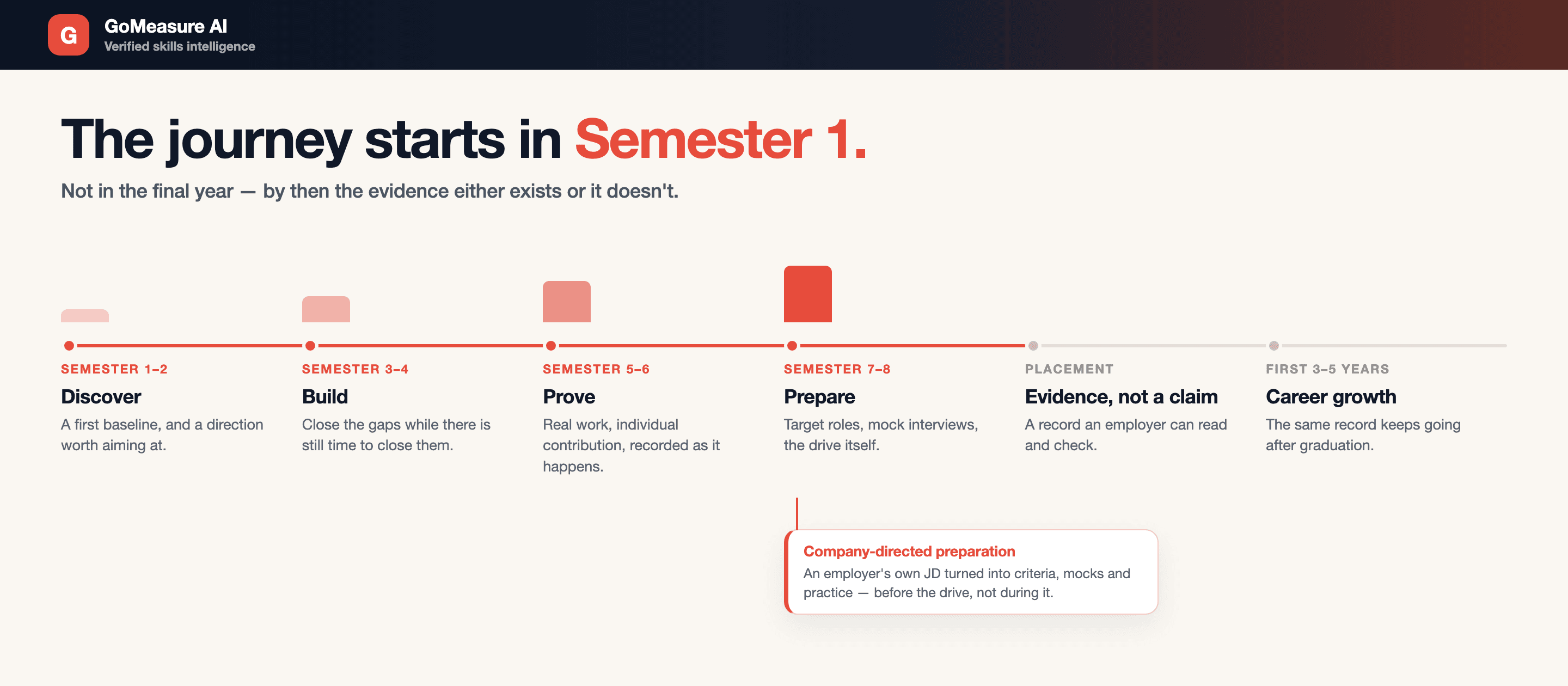
The evidence a student needs in their last semester has to be built in the three years before it. Almost nothing in the category is built to accumulate.
This is not a complaint about the platforms that exist. They solve real problems, and they solve them well. It is an argument that the problem they all leave behind is the same one, and that it is a problem of timing rather than of features. It is also the argument behind GoMeasure Campus, so read it with that in mind.
Three good answers to placement-season problems
The category has broadly converged on three propositions. Each is coherent, each has a clear buyer, and each is described below the way it positions itself publicly rather than the way a competitor would describe it.
Workflow — reduce the administration
Placement management platforms exist because running a season is genuinely hard operational work. Hundreds of employers, thousands of students, eligibility rules that differ per company, a shortlist that changes twice a day, and a placement officer holding it together in spreadsheets. Software that coordinates drives, enforces eligibility and tracks status is doing something unambiguously useful.
What it measures is the process. How many companies came, how many students applied, where each one is in the funnel. It is an operations system, and operations systems are judged on whether the season ran smoothly.
Engagement — create exposure
Engagement platforms start from a different premise: the limiting factor for a student outside the top-tier colleges is not preparation, it is visibility. So they build competitions, hackathons, case challenges and employer-branded contests, and let performance in those become a form of profile. For a student at a tier-2 or tier-3 institution, this is often the only route to being seen by an employer who would never visit the campus.
What it measures is participation and performance in discrete events. A strong showing in a challenge is real evidence — it just arrives as a series of unconnected moments rather than as a trajectory.
Assessment — screen the batch
Employability assessment platforms answer the question an employer actually asks: of these two thousand applicants, which three hundred are worth interviewing? Standardised tests of aptitude, communication and domain knowledge, scored comparably across institutions, give both the employer and the college a defensible filter.
What it measures is a snapshot, standardised. That standardisation is the whole value — it is what makes a score from one college comparable to a score from another. It is also what makes it a single reading taken near the end.
The gap is not a feature. It is a timeline.
Put the three together and a college can run a smooth season, give students exposure, and screen the batch. That is a genuinely better position than most institutions were in ten years ago.
But notice where all three sit on the clock.
A student who discovers in September of their final year that their communication is the thing holding them back has roughly eight weeks to do something about it. A student who learns the same thing in their third semester has two and a half years. Those are not the same intervention, and no amount of improving the September test closes that gap.
The same applies to the college. A placement officer reading a batch report in Year 4 is reading a verdict. A placement officer reading the same signal in Year 2 is reading a plan — which departments need what support, which cohorts are drifting, where to put the training budget while it can still change the outcome.
Where the overlap is real
It would be dishonest to present continuity as a feature nobody else has. Taken capability by capability, the overlap is substantial:
- Diagnostics, mock interviews, preparation plans and dashboards exist in the workflow platforms.
- Practical challenges and candidate evidence exist in the engagement platforms.
- Employability diagnostics, role suitability and structured feedback exist in the assessment platforms.
Any of these can run a diagnostic. Any of these can produce a report. Pointing at a single capability and claiming it as a differentiator would be a claim that does not survive a demo.
The defensible difference, if there is one, is not any individual measurement. It is whether the measurements connect — whether the Year 2 reading, the Year 3 project and the Year 4 assessment sit on one record that a student carries and an employer can read, or whether they are four unrelated artefacts produced by four systems that have never spoken to each other.
The four propositions side by side
| Area | Workflow platforms | Engagement platforms | Assessment platforms | Continuity model |
|---|---|---|---|---|
| Primary proposition | Manage placements and preparation. | Discover opportunities, compete and participate in hiring. | Assess employability and connect candidates with relevant jobs. | Develop and demonstrate role readiness from Year 1. |
| Core emphasis | Placement workflows and employer coordination. | Talent engagement, competitions and recruitment. | Standardised aptitude, communication and domain assessment. | Practical capability, individual contribution and evidence. |
| Student output | Placement profile, preparation results and recruitment status. | Profile, submissions, competition performance and assessment results. | Employability scores and assessment feedback. | Capability transcript, passport, gaps and career ladder. |
| Why a university buys | Reduce placement administration and coordinate drives. | Increase student exposure and employer engagement. | Screen the batch and understand employability gaps. | Track semester-wise development and present defensible role evidence. |
| Honest read on overlap | Diagnostics, interviews, preparation, dashboards, practical challenges and role suitability all already exist across these three. | Differentiation has to come from the depth and continuity of evidence, not from any single capability. | ||
The last row is the one that matters, and it is deliberately unflattering. A new entrant that cannot point at continuity as its reason to exist does not have a reason to exist.
Why continuity is hard, and why most people skip it
There is a good reason the category clusters around Year 4, and it is worth stating plainly rather than pretending the gap is an oversight.
The buyer's urgency is in Year 4. Placement percentage is the number a college is judged on, published, and ranked by. A platform that improves the season has an obvious business case. A platform that improves Year 2 asks an institution to spend money now for a result two years out, which is a harder conversation in any sector.
Students do not feel the problem early. A second-year student has no urgency about a placement that is two years away. Any system that depends on voluntary engagement in Year 2 will see thin participation, which is precisely why it has to be built into the semester rather than bolted onto it.
Four years of data is a four-year commitment. A record that accumulates is only valuable if the institution, the platform and the student all stay for the duration. That is a real risk, and anyone selling continuity should say so: the first cohort to produce a complete four-year record will not graduate for four years.
None of this makes continuity wrong. It makes it slow, which is a different problem — and it explains why the easier propositions got built first.
What to ask any campus platform, including ours
If you run a placement cell and you are being pitched, these are the questions that separate the propositions. They are written to be awkward for every vendor in the category.
- When does the first measurement happen, and what changes because of it? If the answer is the final year, you are buying a filter, not a development programme. That may be exactly what you want — but be clear which one you are buying.
- Does a reading in one semester connect to a reading in the next? Ask to see the same student's record across two measurement points. If the system can only show you two separate reports, it does not have a record.
- What does the student keep? If the evidence lives only inside your institution's account, the student loses it at graduation — which is the moment it becomes most useful to them.
- Can the evidence survive a sceptical employer? "Scored 78%" is not evidence. What was measured, how, when, by whom, and what did the student actually produce? This is the distinction we call proof rather than a score.
- What does it cost the student? Ask directly. A model where the student pays to be assessed changes who participates, and it changes it along exactly the lines a placement cell should worry about.
- What happens to the students who are not placed? Most platforms are structurally oriented towards the ones who are. The students who need the most support are the ones who show up least well in a season report.
Where this leaves the argument
The three established propositions are not wrong and they are not going away. A college that needs its season to run smoothly should buy a workflow platform. A college whose students are invisible to employers should buy exposure. A college that needs to screen two thousand students defensibly should buy standardised assessment.
If you want to see what the fourth proposition looks like in practice rather than in the abstract, the role catalogue is the concrete end of it — fifty-five entry tracks, each with what the work actually involves, what employers screen for and what the role pays, written so a second-year student can use it to choose rather than a final-year student to apply. The measurement layer underneath is the same Human Skills & Capability Platform used for hiring and workforce capability.
The argument for a fourth proposition rests on one claim only: that a record which starts in Year 1 and accumulates is worth more to the student, the institution and the employer than four better snapshots taken at the end. That claim is testable, and it will take a full cohort to test it properly.
Anyone who tells you otherwise — in either direction — is selling you something.
Each category above is described by how platforms in it position themselves publicly. This is a view of the category, not a product review, and the comparison is deliberately framed by proposition rather than by vendor. GoMeasure Campus is new; the continuity claim made here is an argument we intend to be held to, not a result we have already demonstrated.
The whitepaper, the playbooks and new research — by email.
Skills intelligence for HR and business leaders. We'll send the “Jobs to Skills” whitepaper and share new frameworks as we publish them. No noise.
One email now, occasional research later. Unsubscribe anytime.