Coursera released the eighth edition of its Global Skills Report on 29 September 2026, built on learning data from more than 300 million learners across Coursera and Udemy. The new element is the AI-Human Skills Synergy Index, which ranks 98 countries not on AI skill acquisition alone, but on whether populations are building AI capability alongside the human capabilities required to apply it — combined with Oxford Insights' Government AI Readiness Index for the policy and infrastructure half.
That framing is worth pausing on, because it concedes something the market has been slow to admit: AI capability and AI technical knowledge are not the same measurement.
The split inside the ranking
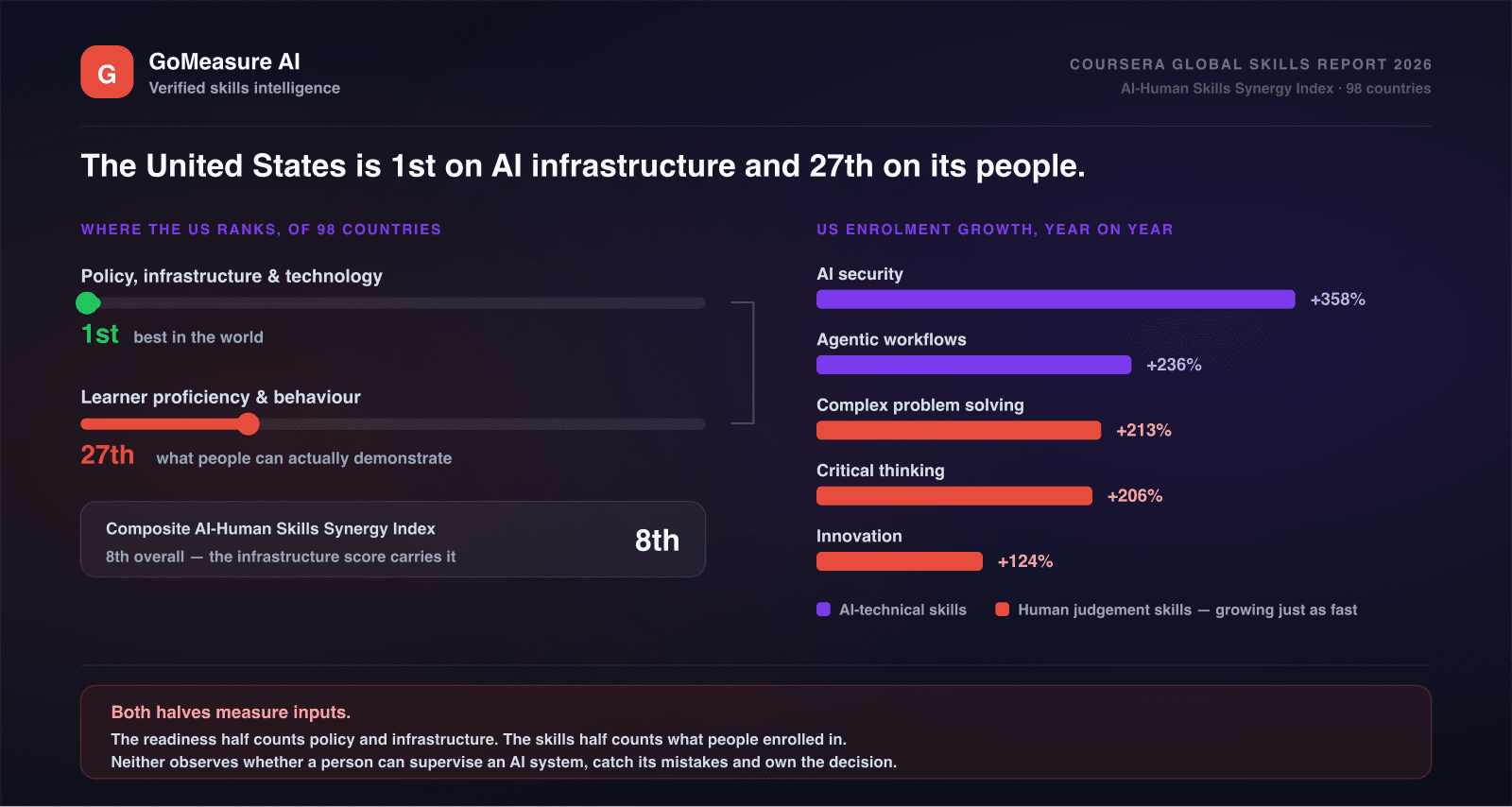
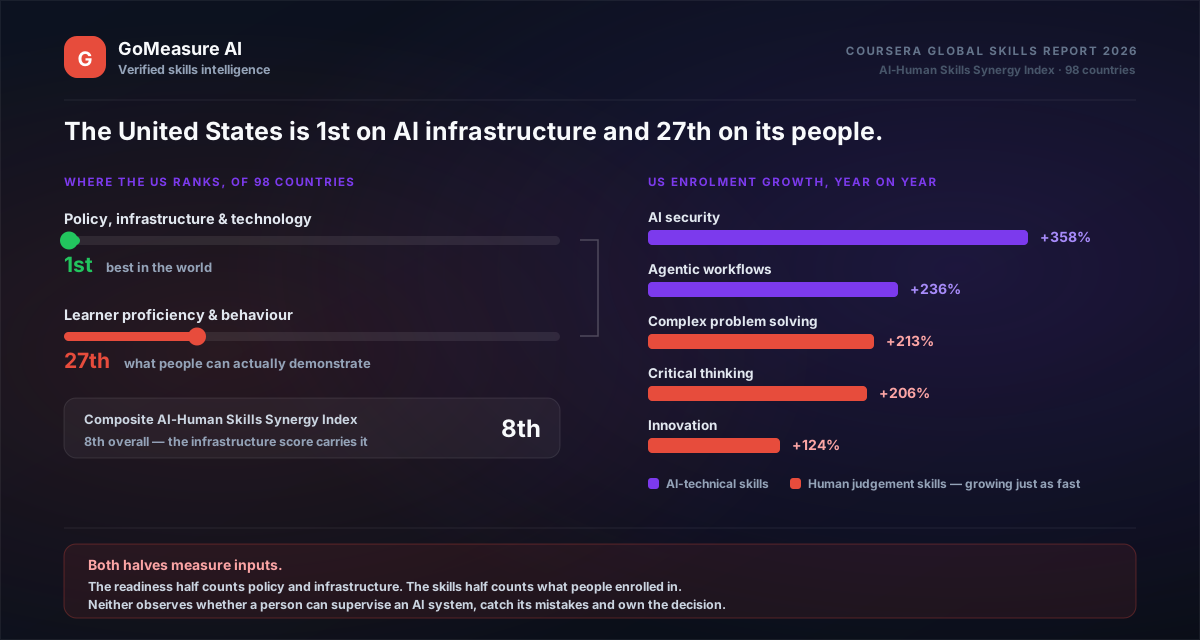
The United States places eighth overall. Underneath that number are two very different scores. On
the indicator covering policy, infrastructure and technology preparedness, it leads the world. On
learner proficiency and behaviour observed on the platform, it ranks 27th of 98. Anthony Salcito,
Coursera's President of Enterprise, put it plainly: the country built the foundation to lead, but
the workforce hasn't caught up
.
Europe dominates the top of the table — 25 of the top 31 nations, with Germany first, France second and the Netherlands seventh. Japan, Korea and Hong Kong put Asia Pacific firmly in the top five. The pattern across the leaders is not who has the most compute. It is where learner behaviour and national readiness move together.
The behavioural data is the useful part
Year-on-year growth in US enrolments shows people reaching for judgement skills at almost exactly the rate they reach for technical ones.
against +67% growth in AI enrolments globally The fastest-moving area in the dataset. Organisations discovered that deploying AI created an attack surface before they had anyone qualified to defend it.
against +107% globally The clearest signal in the report. When AI produces fluent, confident, occasionally wrong output, the scarce skill is the one that interrogates it.
AI-focused micro-credential enrolments rose 84% year on year, against 16% for US micro-credentials overall. Generative AI enrolments now run at more than 45 per minute across the two platforms, up from 25 a year ago.
Read together, these lines say something specific. The workforce is not treating AI capability as a tooling problem. Critical thinking growing at +206% and complex problem solving at +213%, in the same period that agentic workflows grew +236%, is a population behaving as though judgement and tooling are the same purchase. That is the right instinct, and it is the strongest external support yet for a position that has been unfashionable: knowing how to use AI is not the capability that matters. Knowing when to trust it is.
Where the index stops — and why it matters
This is the part that deserves care, because it is a limitation of the data rather than a fault in the work. Both halves of the index measure inputs.
Every organisation reading this report will recognise the position, because it is the position they are in internally. They can report training hours, completion rates and certificates issued. They cannot answer the question a regulator, a board or an incident review actually asks: on the day the model was wrong, was anyone in a position to notice?
What a capability measure has to observe instead
The capability the index is circling — use AI, exercise judgement, detect problems, challenge output, decide, and remain accountable — is what GoMeasure measures as the AI Oversight Quotient. It is scored from demonstrated work rather than declared learning: AI-enabled simulations and adaptive interviews that put a person in front of AI output and observe what they do with it.
Seven dimensions are scored — oversight judgement, delegation boundaries, trust calibration, verification, challenge and override, escalation, and decision ownership — placed on a five-level scale from L1 Emerging to L5 Strategic. In a working session, those dimensions surface as a sequence of observable moves:
None of these can be established from an enrolment record, and none of them are what a multiple-choice AI-literacy quiz tests. They require watching someone work.
What to do with this
The report is a macro signal, but it maps onto a decision most organisations are facing this quarter: AI is already doing consequential work, and nobody can say who is qualified to supervise it. Five steps, in order, and none of them require a programme.
- Stop reporting enrolment as capability. Training hours, completion rates and certificates issued are attendance metrics. They were an acceptable proxy when courses taught procedures; they are not one when the thing being learned is judgement. The distinction is covered in AI literacy versus AI proficiency, and the same gap exists in HR systems — see HRMS skills versus verified skills.
- Find where AI is already doing consequential work. In most organisations this is ahead of policy and invisible to L&D, because it arrived through individuals rather than procurement. Shadow AI use is where the oversight risk actually sits, and it is the list that tells you which roles to measure first.
- Baseline oversight on those roles before authorising more AI. Run the AI Oversight Quotient against the people already making AI-assisted decisions, and place them on the five-level scale with the evidence attached. The measurement is built from demonstrated work — see AI-era assessments for how the simulations and adaptive interviews are constructed, and the methodology for how evidence is scored.
- Pick one process and measure either side of it. Not a capability programme — a pilot on a single process where AI is already in use, measured before and after, so the result is arguable from evidence rather than sentiment. The shape is in running a skills gap analysis as a pilot, and the business case in proving ROI from AI adoption.
- Give the board a capability number instead of an attendance number. The question at board level is not how much training was delivered; it is whether the organisation can demonstrate effective human control over AI-assisted decisions. The capability risk your board is not measuring sets out what that reporting line looks like.
What to take away
- Coursera's new index is a genuine shift: it scores AI skills paired with human skills rather than alone. The framing is right, and it is external validation that AI capability is not AI technical knowledge.
- The headline US result is a split, not a rank. First on infrastructure, 27th of 98 on people, composite 8th. The composite hides the finding.
- Judgement skills are growing at technical-skill rates — critical thinking +206%, complex problem solving +213% — which means the workforce has already worked out what the capability actually is.
- Both halves of the index measure inputs. Enrolment is intent; completion is attendance. Neither observes a person supervising an AI system under real conditions.
- That is the gap organisations have internally too. Training hours are reportable; oversight is not, unless it is measured from demonstrated work.
The whitepaper, the playbooks and new research — by email.
Skills intelligence for HR and business leaders. We'll send the “Jobs to Skills” whitepaper and share new frameworks as we publish them. No noise.
One email now, occasional research later. Unsubscribe anytime.