
Every strategy is a bet on capability
Enter a new market. Ship the transformation. Roll out AI across operations. Defend the core against a faster competitor. Whatever the plan, it carries an unspoken assumption: that the organisation has the capability to execute it. Strategy is, in the end, a bet on your people's ability to deliver.
So it's worth asking a blunt question in the boardroom: for the strategy you just committed to, how confident are we that we can execute it — and what is that confidence based on? In most companies, the honest answer is a feeling. Not data. A feeling.
The one risk with no data, no owner, no review
Compare that to how the board handles every other major risk. Each one has a discipline around it: a source of data, a named owner, and a regular review.
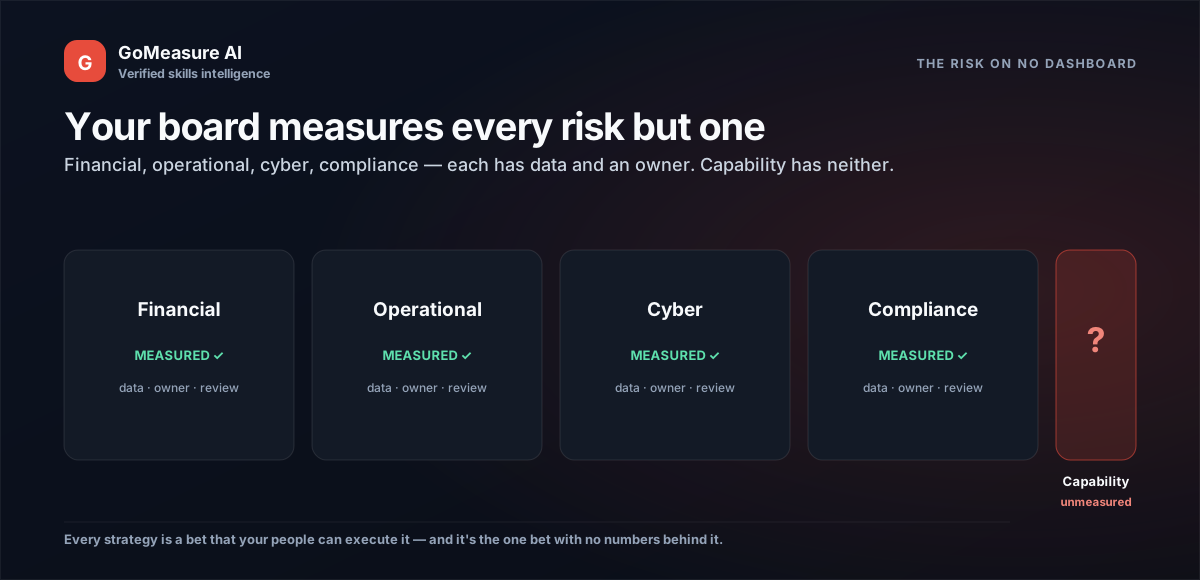
That's the blind spot: the risk that determines whether every other plan succeeds is the one the board has the least real data on. It isn't ignored because it doesn't matter — it's ignored because, until recently, it couldn't be measured. So it fell off the register.
Why the blind spot just got dangerous
Capability risk has always existed. Three things have made it acute now:
- Skill gaps are the number-one barrier. In the WEF Future of Jobs Report 2025, 63% of employers name skill gaps as the single biggest barrier to business transformation — ahead of every other constraint.
- Skills change faster than ever. With skill half-lives now a few years and shorter in technical fields, the capability you had is not the capability you have. A once-a-year read is already stale.
- The agenda is capability-heavy. AI adoption, transformation and new-market plays are all bets on whether the workforce can do something it hasn't done before — exactly where a gut feel is most likely to be wrong.
What it takes to close it
Bringing capability onto the risk register means giving it the same three things every other risk already has:
- Real data — capability measured on evidence, not inferred from profiles or self-rated in a review. This is the difference between guessing at a skill and proving it.
- Mapped to strategy — that capability read against what your specific plans require, so you can see where you're strong, thin or exposed relative to the strategy, not in the abstract.
- Kept current — re-verified as skills and strategies change, so it's a live position, not an annual snapshot.
That combination — verified, mapped, current — is what a Skills Intelligence layer provides. It turns "we think we can execute" into a position you can put in front of a board with the evidence behind it — the same standard you'd expect for any other risk of this size.
The short version
- Every strategy is a bet that your people can execute it — capability is the underlying risk.
- Financial, operational, cyber and compliance risk each have data, an owner and a review. Capability has none of them.
- It's a blind spot not because it doesn't matter, but because it couldn't be measured — so it fell off the register.
- Skill gaps are now the #1 barrier to transformation, skills change faster, and the agenda is capability-heavy — so the blind spot is now dangerous.
- Closing it means measuring capability on evidence, mapping it to strategy, and keeping it current — a board-grade view of whether you can actually deliver.
Put capability on the dashboard.
GoMeasure gives leadership a measured, evidence-backed view of whether the workforce can execute the strategy — mapped to your plans and kept current. Turn the one unmanaged risk into one you can see. Start with the capabilities your next big bet depends on.
Talk to us about capability Start with the guide →The whitepaper, the playbooks and new research — by email.
Skills intelligence for HR and business leaders. We'll send the “Jobs to Skills” whitepaper and share new frameworks as we publish them. No noise.
One email now, occasional research later. Unsubscribe anytime.