
1. What a skills-based organisation actually is
A skills-based organisation (SBO) is one where the primary unit of talent decision-making is the skill — not the job title. Work is understood as a set of capabilities to be deployed, developed and verified, and the major people decisions — who to hire, move, promote, develop and plan around — are made against evidence of those capabilities rather than against proxies like tenure, credentials or the wording of a job description.
That definition has a load-bearing word in it: evidence. It is the difference between an organisation that has re-labelled its jobs with skill tags and one that has genuinely changed how decisions get made. Both can buy the same platform; only one has transformed.
A mature SBO exhibits four properties. Talent is deployed against capability rather than headcount slots. Capability is visible across roles, teams and the whole organisation as a living map. Decisions are defensible — every one can be traced to evidence, a method and a date. And the picture is current — skills are re-verified as they decay and grow, rather than captured once and left to rot.
2. Why traditional job-based models are insufficient
The job description was a reasonable abstraction for a slower world: stable roles, predictable career ladders, work that fit inside a box for years at a time. That world is gone, and the data shows the box no longer describes the work.
Deloitte's research — 1,021 workers and 225 business and HR executives — found that 63% of the work being performed today falls outside people's core job descriptions. 81% say work is increasingly performed across functional boundaries. 36% say it is increasingly done by people outside the organisation who have no defined job at all. The unit of account — the job — has quietly stopped matching the unit of work.
Job-based models fail in four specific ways:
- They hide capability. A title tells you what someone was hired to do, not what they can actually do. The employee who can already perform the open role — but whose title doesn't say so — stays invisible, and the role gets filled from outside at greater cost and risk.
- They measure the wrong thing. Tenure, credentials and past titles are proxies for capability, not capability itself. In an era where AI can fabricate a flawless résumé and rehearse a flawless answer, proxies are weaker than ever.
- They are rigid where work is fluid. Cross-functional, project-shaped and increasingly AI-augmented work does not respect role boundaries. A model whose atomic unit is the fixed job cannot represent it.
- They cannot answer the questions leaders now ask. "Who can already do this?" "Where is our capability thin?" "Is this person ready for the next level — on evidence?" A job architecture has no vocabulary for any of these.
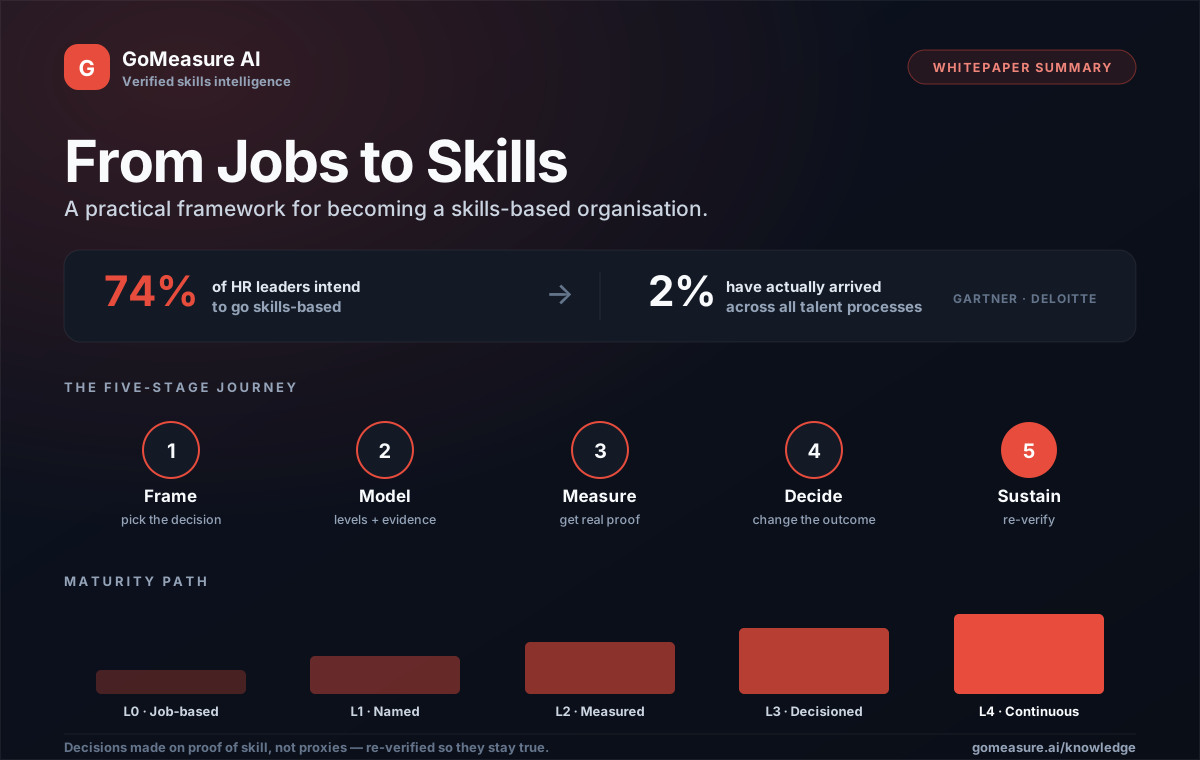
The prize for fixing this is measurable. Organisations that make the shift report being 79% more likely to provide a positive workforce experience and 63% more likely to achieve results. And yet Gartner found that while 74% of HR leaders believe most organisations are moving to a skills-based model, only 2% have adopted one across all their talent processes. 41% have some processes in place; 50% are still thinking about it. The intent is near-universal; the execution is rare. The rest of this framework is about why, and how to be in the 2%.
3. The maturity model
Transformation is not binary. Organisations move through recognisable levels, and most that describe themselves as "skills-based" are earlier on the curve than they think — usually at Level 1, mistaking an inventory for an operating model. Locating yourself honestly is the first act of the transformation.
Two things about this model matter more than the labels. First, the jump from L1 to L2 is where most programmes die — it is the step from naming skills to proving them, and it is unglamorous, so it gets skipped. Second, L2 to L3 is the only jump that produces business value: measurement that never changes a decision is a cost, not a capability.
4. The major transformation stages
The maturity model describes where you are. The five stages describe how you move. They are deliberately sequenced — most stalled programmes fail because they attempted a later stage before an earlier one, most commonly modelling the whole enterprise before knowing which decision the model had to serve.
Stage 1 — Frame: start from a decision, not an inventory
Choose one people decision that is made repeatedly, made badly today, and owned by someone who feels the pain — shortlisting for a critical role, readiness for the next level, redeploy-versus-backfill, or whether training actually worked. A decision imposes scope discipline: you need only the skills that decision turns on, typically eight to twenty, not three thousand. Document the decision, what currently feeds it, and exactly how it fails.
Stage 2 — Model: turn the list into an ontology
For that narrow set of skills, define what each proficiency level means and what evidence would count as proof at each level. This is the move from taxonomy (a controlled vocabulary of skill names) to ontology (hierarchy, levels, relationships and evidence rules). It is the least glamorous stage and the whole ballgame: a scale without evidence rules is an opinion with numbers on it.
Stage 3 — Measure: get proof for the few skills that matter
Now assess — honestly matching method to skill. Inference predicts, testing samples, completion records attendance; only proof survives a challenge. Different skills demand different shapes of evidence, so a single instrument applied to all of them measures none well. The bar to hold: could you defend this rating, with evidence, to the person it disadvantaged?
Stage 4 — Decide: wire proof into the decision
Put the evidence in front of the decision-maker at the moment of the decision — inside the shortlist, the succession review, the staffing conversation — not in a dashboard they must remember to visit. Then watch the only signal that matters: does the decision come out differently? Record the rationale alongside the outcome so it is auditable later.
Stage 5 — Sustain: re-verify and govern at scale
Set a freshness policy per skill, because skills decay and an unrefreshed graph becomes a liability within roughly eighteen months. Then widen: each proven decision loop generates fresh evidence that sharpens the next, and the governance established in one loop becomes the template for the next. One loop that compounds beats forty roles mapped once.
You cannot define "what evidence would count" in the abstract. Evidence is only ever sufficient relative to a decision. Choose the decision first — and most of the modelling questions answer themselves.
5. Governance and evidence requirements
What separates a defensible skills-based organisation from a risky one is the quality of its evidence and the governance around it. A people decision made on skill data is only as safe as the data underneath it — and in most jurisdictions it is also a decision you may have to justify. Five properties make a skill signal count as proof rather than assertion:
- Validated — produced by a method appropriate to the skill, not self-declared or inferred from a profile.
- Source-tagged — traceable to the specific evidence it rests on (which answer, which artefact, which observed behaviour).
- Dated and fresh — carrying a timestamp and a freshness policy, so a stale rating is visibly stale rather than silently trusted.
- Defensible and auditable — reconstructable after the fact, with the method, the evidence and the decision rationale on record.
- Consistent — measured on the same scale across people, so two ratings can actually be compared.
Around the evidence sits the governance that makes the system trustworthy — and legal:
- Fairness and adverse-impact monitoring. Skills-based decisions can encode bias just as job-based ones did. Monitor outcomes across groups and be able to show the basis of any decision.
- Ownership and consent. Be explicit about what is measured, why, and who can see it. Verified skills should belong to the person as well as the employer — portable, not captive.
- A decision audit trail. Log the evidence, method, date and rationale for every decision the system informs, so "the model said so" is never the answer to a challenge.
- Human accountability. The system informs decisions; a named human owns them. Close calls route to a person, not a threshold.
6. How to interpret the assessment
Use the maturity model as a diagnostic. Score your organisation honestly on each of the six dimensions below from 0 to 4, where the number corresponds to the maturity level (L0–L4) you have genuinely reached for that dimension — evidenced by practice, not intention.
- Decision basis — do real people decisions run on verified skill evidence, or on titles, tenure and gut feel?
- Skill model — do you have levels and evidence rules (an ontology), or just a list of skill names (a taxonomy)?
- Evidence quality — are skill ratings validated and source-tagged, or self- and manager-declared?
- Coverage — is capability visible for the decisions that matter, across roles and teams?
- Freshness — is skill data re-verified on a policy, or captured once and left to decay?
- Governance — can you defend any skills-based decision with evidence, method, date and rationale?
Add the six scores for a total out of 24, and read against the bands below. The rule of interpretation: your maturity is set by your weakest load-bearing dimension, not your average. Strong coverage means nothing if the evidence underneath is self-declared; a beautiful ontology is inert if no decision uses it.
Most organisations that run this honestly land in the 7–13 band — a real skill model, but decisions still made the old way. That is not failure; it is the exact point at which the L1→L2→L3 jumps deliver the most value.
7. How GoMeasure supports the journey
GoMeasure is built to move an organisation through these stages on evidence rather than assertion. It maps to the framework directly:
- Model (Stage 2) — a skills graph that goes beyond a taxonomy: a ~33,000-skill global library an organisation can fork and extend, with the levels, relationships and evidence rules that turn a list of names into a measurable ontology.
- Measure (Stage 3) — the Proof Engine: adaptive AI-led interviews and assessments matched to how each skill actually shows up, with TrustOS integrity monitoring so every score is validated and source-tagged rather than self-declared.
- Decide (Stage 4) — verified evidence surfaced inside the decision itself: ranked shortlists, internal-mobility matches, succession benches and readiness — each traceable to the evidence behind it.
- Sustain (Stage 5) — re-verification that keeps proof current as skills change, a portable verified record the person owns, and an audit trail that makes every decision defensible.
The design principle behind all of it is the one this whitepaper opened with: don't build a skills database that decisions will one day consult — rebuild one decision so it runs on proof, then do it again. The database is the by-product; the changed decision is the point.
Key takeaways
- A skills-based organisation is defined by decisions made on proof of capability — not by owning a list of everyone's skills.
- Job-based models are insufficient because 63% of work now falls outside job descriptions; titles and tenure hide capability and can't answer the questions leaders now ask.
- Maturity runs L0 job-based → L1 named → L2 measured → L3 decisioned → L4 continuous; most "skills-based" organisations are stuck at L1, mistaking an inventory for an operating model.
- The transformation is five sequenced stages — Frame, Model, Measure, Decide, Sustain — and the value only appears when measurement starts changing decisions.
- Governance and evidence quality are what make it defensible: validated, source-tagged, dated, auditable, consistent proof, with fairness monitoring and a decision audit trail.
- Score yourself on six dimensions; your maturity is your weakest load-bearing dimension, not your average — and the next move follows directly from the band you land in.
The distance between 74% intending and 2% arriving is not closed by a bigger taxonomy or a better dashboard. It is closed one decision at a time, each rebuilt to run on proof and then re-verified so it stays true. That is the whole journey from jobs to skills — and it is a system you operate, not a project you finish.
The whitepaper, the playbooks and new research — by email.
Skills intelligence for HR and business leaders. We'll send the “Jobs to Skills” whitepaper and share new frameworks as we publish them. No noise.
One email now, occasional research later. Unsubscribe anytime.