
A quick scene you'll recognise
You want to know whether your Sales Managers have the right skills. So you buy a ready-made "Sales Manager" skills assessment — proper questions, a proper score at the end. It feels like the thorough, objective thing to do.
But here's the catch nobody mentions at purchase: that assessment was built for a standard Sales Manager — and yours isn't standard. Your Sales Managers sell a technical product into a regulated industry, so what actually matters for them is different from the generic template. The test doesn't know that. It measures the standard role, carefully and confidently — and quietly misses the point.
Why ready-made assessments have to be generic
This isn't a knock on the vendors. A pre-built assessment is built once and sold to everyone. For that to work, it has to describe a role in the most general way possible — the skills a "typical" Sales Manager needs, averaged across every company that might buy it.
That's exactly what makes it convenient. It's also exactly what makes it a poor fit for your role — because an average of everyone's role is nobody's actual role.
The mismatch, drawn out
Say the off-the-shelf test covers 8 standard skills — 5 "must-have", 3 "nice-to-have". Now look at what your version of the role genuinely needs. Some skills overlap. Most don't.
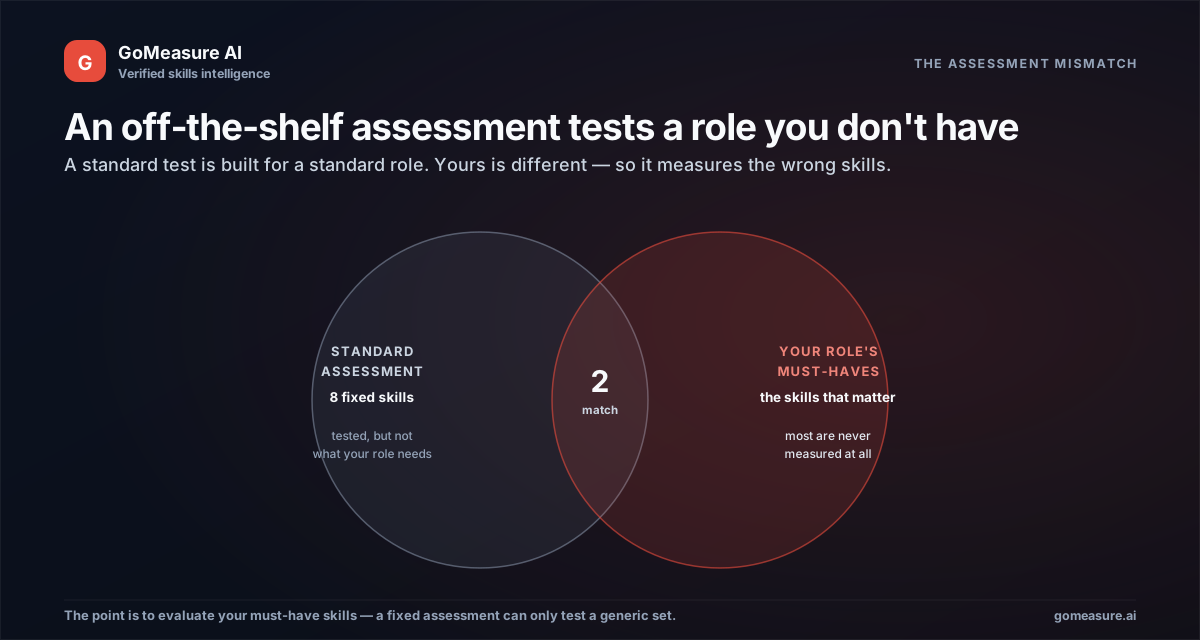
Two things go wrong at once, and both are expensive:
So you get a confident-looking score that is measuring the wrong thing. Someone can "pass" the standard assessment and still be missing the capabilities your role actually depends on — because those were never on the test. And someone genuinely great for your role can score poorly because the test spent its questions elsewhere.
The fix: measure your must-haves, not a template
The way out isn't a bigger question bank. It's measurement that adapts to your role instead of a generic one. Two things have to be true:
- Start from your role's real skills. The must-have skills for your version of the role — defined by you, not inherited from an averaged template. (This is why a clear skills map of your own roles matters before any measurement.)
- Measure those specific skills, well. An adaptive, interview-based measurement can probe the exact skills your role needs — and different skills need different kinds of evidence, which a one-size test can't provide — so the score reflects fit for your job, not a stranger's.
Measurement is good. Measurement of the right skills is what you were actually trying to buy.
The short version
- A pre-built skills assessment is made for a standard role and sold to everyone, so it has to be generic.
- Your version of the role has different must-have skills — often only a couple overlap with the standard set.
- So the test measures skills you don't need and misses the ones you do — a confident score answering the wrong question.
- The fix isn't more questions; it's measurement that adapts to your role's real must-have skills.
- Measurement is only useful when it's measuring the skills that actually matter for the job in front of you.
Deciding between skills tools more broadly? We break down the three ways a tool can claim to "measure skills" — and how to tell them apart before you buy — in inferred, tested, or proven: a buyer's guide.
Test your role — not a template of it.
GoMeasure measures the must-have skills of your roles — adaptively, on evidence — instead of grading people against a generic assessment built for someone else's org. Pick one role and see the difference.
See it on one of your roles How the Skills Graph works →The whitepaper, the playbooks and new research — by email.
Skills intelligence for HR and business leaders. We'll send the “Jobs to Skills” whitepaper and share new frameworks as we publish them. No noise.
One email now, occasional research later. Unsubscribe anytime.