Give ten people the same AI tools and you get ten very different results — different quality, different risk, different amounts of real human value added. The difference isn't access. It's capability. Yet most organisations still assess it with a binary: has this person used AI or not? That question can't tell the person who supervises a model and owns the outcome from the one who pastes its output unread. This is the operating problem behind our 16 HR struggles in the AI era — specifically measuring AI-era capability and performance that no longer reflects contribution.
Working with AI is not one skill
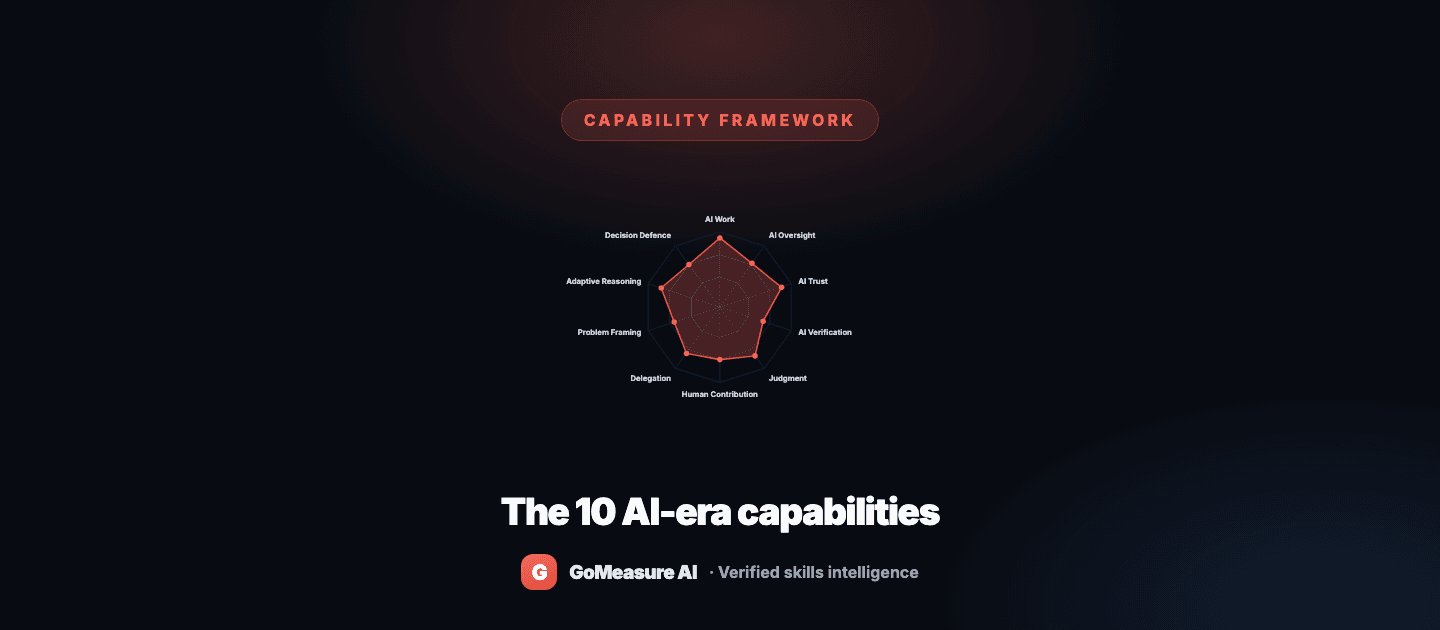
It decomposes into capabilities that can be defined, observed and scored independently. Some are about producing with AI; some are about controlling it; some are about the distinctly human judgement that decides whether the output is any good. GoMeasure organises them as ten AI-era capabilities — each expressed as a Quotient, our way of measuring and scoring that capability from demonstrated work.
The 10 AI-era capabilities
The six linked above are covered in depth in this series; Delegation, Problem Framing, Adaptive Reasoning and Decision Defence follow next.
One scale for all ten: Emerging to Strategic
Every capability is read on the same five levels, so a person's AI-era profile is comparable across dimensions and over time. The levels describe observable behaviour, not self-belief:
Why measure capabilities, not tools
- Access is now universal; capability is not. The differentiator has moved from whether people use AI to how well they control it.
- Output hides the gap. AI lets a weak performer ship acceptable-looking work, so a normal review never sees that the judgement underneath is thin. Capability measures catch what output conceals.
- Different roles need different capabilities. An auditor lives on Verification and Oversight; a strategist on Problem Framing and Judgment. The framework lets you require the right ones per role.
- It makes development concrete. "Move from L2 to L4 on Verification" is a coachable, re-measurable goal in a way that "get better at AI" never is.
How GoMeasure measures them
Not with self-ratings or multiple-choice quizzes — those measure confidence and recall, not capability. GoMeasure reads each Quotient from demonstrated work: AI-enabled work simulations, adaptive AI interviews with identity and integrity assurance, and evidence from real tasks — then places the person on the five-level scale with the evidence attached in a Verified Passport. The result feeds hiring, deployment, development and governance decisions with proof rather than assumption. Explore the assessment portfolio to see how the capabilities map to roles.
Key takeaways
- "Can you use AI?" can't distinguish real AI-era performance. Working with AI decomposes into ten measurable capabilities.
- They span producing with AI (AI Work), controlling it (Oversight, Trust, Verification, Delegation) and the human judgement that decides quality (Judgment, Human Contribution, Problem Framing, Adaptive Reasoning, Decision Defence).
- Each is read on one five-level scale — Emerging → Developing → Proficient → Advanced → Strategic — describing observable behaviour.
- Measuring capabilities, not tool familiarity, catches what AI-inflated output hides and makes development concrete and re-measurable.
- GoMeasure measures them from demonstrated work, with evidence attached — as a framework designed to be piloted and calibrated before high-stakes use.
Frequently asked questions
What are the AI-era capabilities that actually matter?
Ten measurable capabilities: AI Work, AI Oversight, AI Trust, AI Verification, Judgment, Human Contribution, Delegation, Problem Framing, Adaptive Reasoning and Decision Defence — each defined on a five-level scale from Emerging to Strategic.
Why isn't "can you use AI" a good enough measure?
Tool familiarity says nothing about whether a person supervises AI responsibly, catches its errors or adds real value on top of it. Two people with identical AI access can produce very different quality and risk.
How do you measure these capabilities objectively?
From demonstrated work — AI-enabled work simulations and adaptive AI interviews with identity assurance — placing each person on the five-level scale with the evidence attached, rather than relying on self-ratings.
Start with the six flagship capabilities below, or read the wider context in the 16 HR struggles in the AI era. To see how the capabilities map to roles, explore the assessment portfolio.
The whitepaper, the playbooks and new research — by email.
Skills intelligence for HR and business leaders. We'll send the “Jobs to Skills” whitepaper and share new frameworks as we publish them. No noise.
One email now, occasional research later. Unsubscribe anytime.