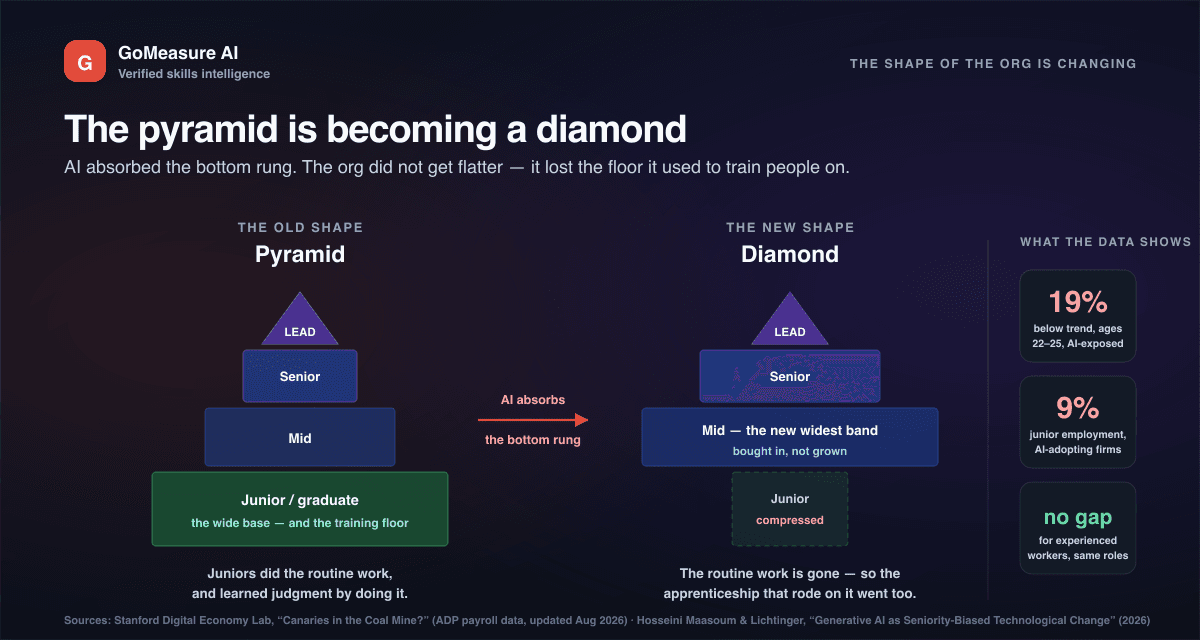
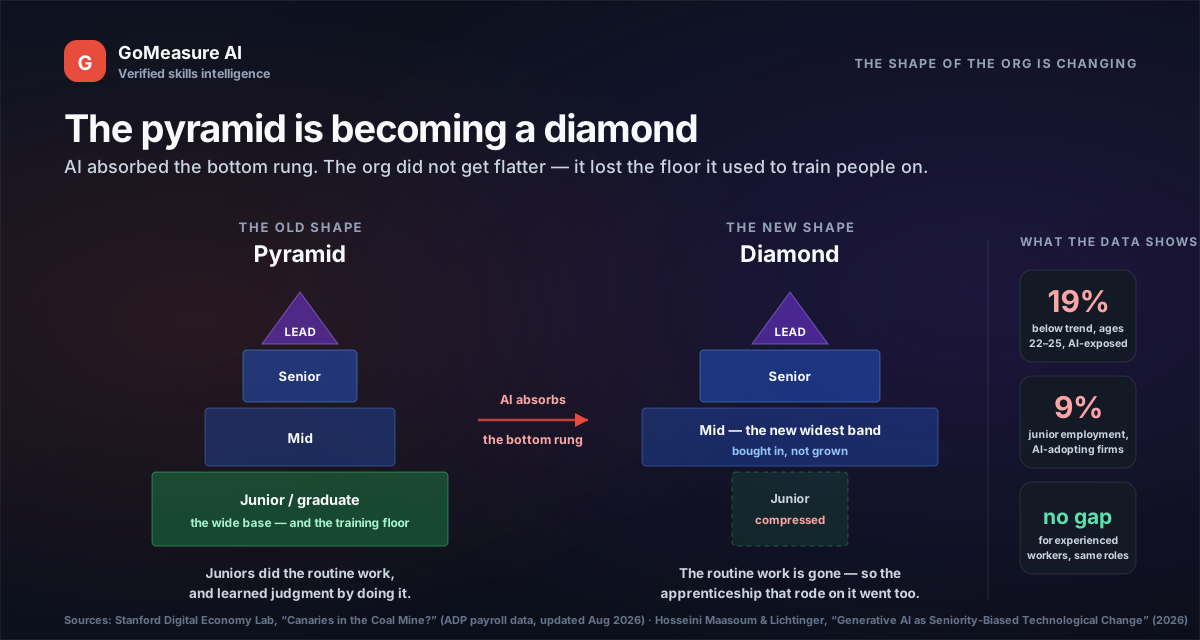
Every org chart most of us learned was a pyramid. A narrow leadership tip, a working middle, and a wide base of juniors and graduates doing the volume work — the first-pass research, the first-draft deck, the reconciliation, the ticket triage, the document review. The base was the biggest cost line and the biggest headcount. It was also, though almost nobody wrote it down this way, the company's apprenticeship programme.
That shape is changing. The base is compressing while the middle widens. The result is a diamond.
What the evidence actually says
This is a topic where the numbers circulating are considerably worse than the numbers in the research. It is worth being precise, because the strategic response to a 9% shift is different from the response to a collapse.
“Canaries in the Coal Mine?”
ADP payroll data, updated Aug 2026 Employment of 22–25 year olds in highly AI-exposed occupations, against same-age workers in less-exposed occupations. Roughly 19% below where it would be had it kept pace. The gap was 15% in July 2025. Experienced workers show no comparable gap.
“Generative AI as Seniority-Biased Technological Change”
65m workers, 280,000+ US firms, 2015–2025 Junior vs senior employment at firms that adopted generative AI, against firms that did not. Junior employment fell about 9% after six quarters at adopting firms. Senior employment kept rising. Driven by reduced hiring, not redundancies.
Two independent datasets, two different methods, and the same shape: the bottom of the pyramid compresses while the middle and top do not. That is the diamond, and it is showing up in payroll data, not in predictions.
Why the diamond forms
Entry-level roles were never defined by the difficulty of the work. They were defined by its volume and routineness. Summarise these fifty documents. Pull this data into a model. Draft the first version. Check these records against those records. That work was the reason to hire a junior, and it is precisely the work generative AI does acceptably well on the first pass.
So the economics invert. A manager who needed four analysts to get through the volume now needs one who can direct AI through it and check the output. That manager does not need a graduate — they need someone who already knows what wrong looks like. Hiring shifts to the middle. Nobody decided to stop developing talent; a thousand local, sensible hiring decisions added up to it.
The part that costs you later
Here is the trap. The wide base was not just cheap labour. It was the mechanism by which people acquired judgment. A junior analyst who reconciles a thousand records develops an instinct for what a wrong record looks like. That instinct is what makes them a useful mid-level hire three years later. The boring work was the curriculum.
Three of those five rows are unsolved, and all three are invisible this year. That is what makes this a governance problem rather than a hiring problem: the saving lands in the current budget and the cost lands in someone else's, two to five years out. For a related mechanism inside the work itself, see cognitive debt and distributed deskilling.
The market maths nobody is doing
Cutting graduate intake is rational for one firm in isolation. The problem is that it is rational for every firm simultaneously, and the middle of the market is a shared pool. If the whole industry stops producing mid-level people for four years, then in four years the whole industry is competing for a cohort that was never grown.
The predictable results: mid-level compensation inflates faster than budgets, tenure shortens as those people become permanently poachable, and the firms that kept a junior pipeline end up as involuntary training providers to the ones that did not. If you are modelling only the headcount saved this year, you are modelling one side of the trade.
What breaks in the HR operating model
Most HR machinery assumes a pyramid. When the shape changes, processes that were sound start producing wrong answers without anyone getting a warning.
What to actually do
This does not argue for hiring juniors you have no work for. It argues for being deliberate about a trade you are currently making by accident.
The measurement problem underneath all of it
The pyramid quietly supplied HR with its most useful signal: time served. Because everyone entered at the base and moved up through the same work, years of experience was a decent proxy for capability. It was never exact, but it correlated well enough to run hiring, pay and promotion on.
The diamond removes that. Two people with the same three years now have genuinely different capability depending on how much of the work they did themselves and how much they supervised. The proxy has stopped tracking the thing it was standing in for — and for a smaller junior intake, where each seat carries more weight, guessing is more expensive than it used to be.
So the response is not to hire on the old signal harder. It is to measure the capability directly: what someone can actually do with AI, where their judgment holds and where it does not, and what evidence supports the claim. That is the work behind our AI-era capability framework, the levels of working with AI, and the difference between inferred, verified and proven skills. If you are cutting the base, the people you keep have to be measured properly rather than assumed.
What to take away
- The shift is real and visible in payroll data, but it is a structural tilt — roughly 9% at adopting firms, and a 19% gap for 22–25 year olds in AI-exposed occupations — not the collapse the “80%” headlines describe.
- It is driven by hiring freezes, not redundancies. That makes it quiet, cumulative and easy to miss until the middle is empty.
- The wide base was the training system. Removing it solves throughput and leaves judgment, pipeline and succession unsolved.
- Rational for one firm, irrational for all firms at once: everyone buying mid-level from a pool nobody is filling.
- Years of experience has stopped being a safe proxy for capability. With fewer junior seats, each selection decision carries more weight — so measure capability directly rather than inferring it from tenure.
The whitepaper, the playbooks and new research — by email.
Skills intelligence for HR and business leaders. We'll send the “Jobs to Skills” whitepaper and share new frameworks as we publish them. No noise.
One email now, occasional research later. Unsubscribe anytime.