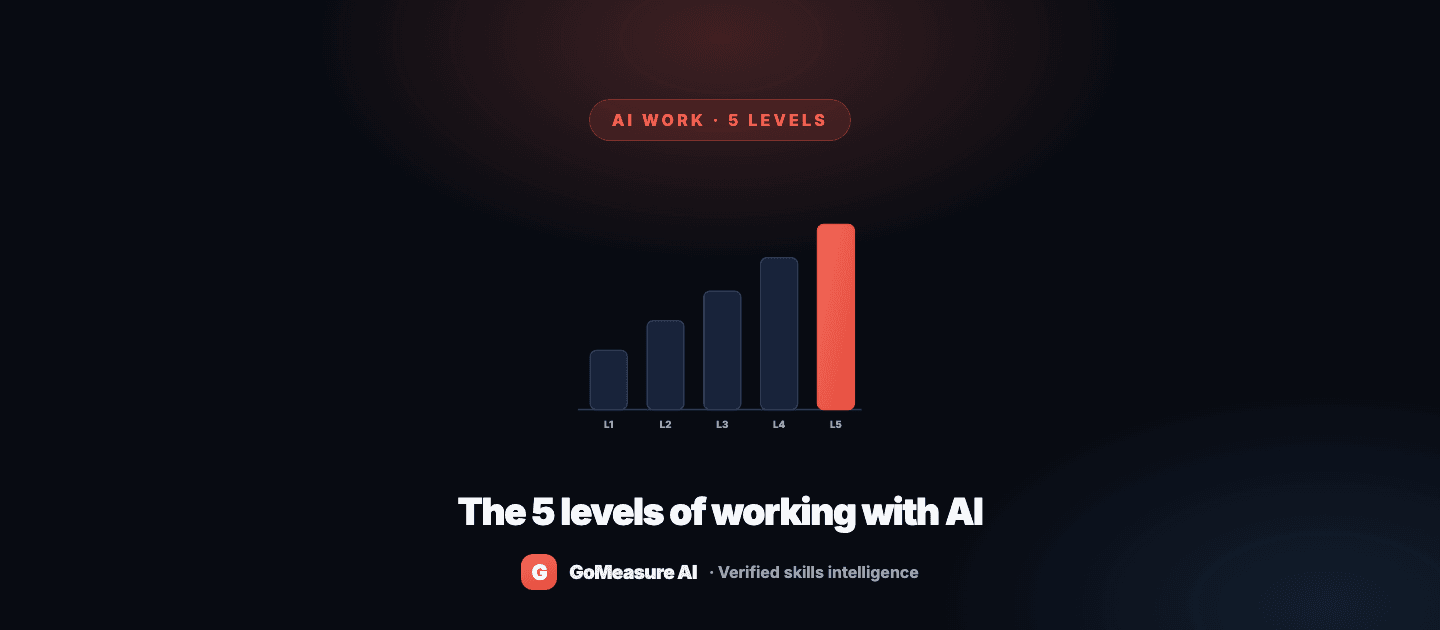
The moment everyone has AI, having AI stops being the differentiator. What separates people now is how well they work with it — and that spread is enormous. This is the AI Work capability in GoMeasure's framework of 10 AI-era capabilities, and it's not the same thing as AI literacy: literacy is knowing about AI, this is producing reliable work with it.
What "working with AI" actually involves
It's the ability to work productively and safely with AI — the "safely" matters, because raw speed that adds error or control risk isn't a win. The underlying behaviours: task decomposition, prompting and context, AI orchestration and tool choice, iteration, verification, workflow efficiency, and knowing when to apply a human override.
The five levels of AI-enabled work
The kind of question it asks
"Break this assignment into steps and identify where AI adds the most value. Then improve this weak AI draft in no more than three interaction cycles — and tell me which outputs you'd accept, revise, reject or escalate."
That surfaces the whole capability at once: decomposition, judgement about where AI helps, efficient iteration, and verification discipline. (Illustrative — a design example, not a validated item.)
Who relies on it, and what it decides
This is the everyday capability Talent Acquisition, L&D, Digital Transformation, AI Centres of Excellence and department managers care about. It informs hiring, deployment, who needs AI training, and where a productivity investment will actually pay off — because it identifies who can convert AI access into reliable, scalable output rather than risky speed.
How GoMeasure measures it
The AI Work Quotient (AIWQ) is read from demonstrated tasks in work simulations — decomposing a real assignment, improving a weak draft in limited cycles, and making accept/revise/reject/escalate calls — placing the person on the five-level scale with the evidence attached, and pairing it with targeted development. It's a framework and rubric, designed to be piloted and calibrated for fairness before high-stakes use.
Key takeaways
- "Working with AI" is a capability with a wide spread — from basic tool use to designing repeatable AI operating models.
- It's distinct from AI literacy: literacy is knowing about AI, AI Work is producing reliable, verified output with it.
- The five levels run L1 Emerging → L5 Strategic, and "safely" matters as much as "productively".
- GoMeasure measures the AI Work Quotient from demonstrated tasks, not tool familiarity — designed to be piloted and calibrated before high-stakes use.
Frequently asked questions
What does "working with AI" involve?
Decomposing a task, prompting with good context, orchestrating tools, iterating, verifying output and knowing when to override — converting AI access into reliable results without adding quality, trust or control risk.
How is it different from AI literacy?
Literacy is knowing about AI; the AI Work Quotient is demonstrated productivity with it. Someone can be literate and still sit at L1 on producing real, verified output.
How do you measure it?
From demonstrated tasks — simulations where a person decomposes an assignment, improves a weak draft in limited cycles and makes accept/revise/reject/escalate calls — placing them on the five-level scale with evidence attached.
The whitepaper, the playbooks and new research — by email.
Skills intelligence for HR and business leaders. We'll send the “Jobs to Skills” whitepaper and share new frameworks as we publish them. No noise.
One email now, occasional research later. Unsubscribe anytime.