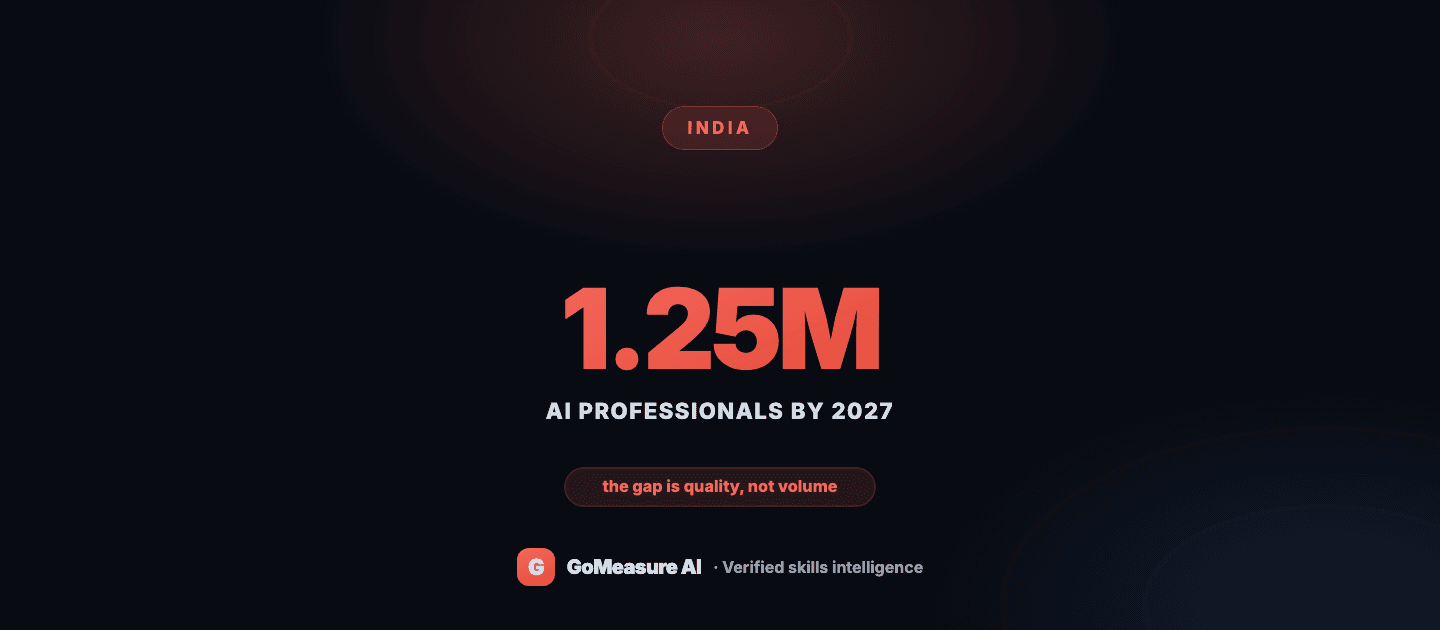
India has genuine scale: a huge pipeline of engineers, a booming set of AI courses, and one of the world's largest concentrations of GCCs. Yet the same forces that create volume also make quality hard to see. This is the India lens on our 16 significant HR struggles in the AI era.
Why it's a quality gap, not a volume gap
- Signals have inflated. AI-assisted CVs, certificates and portfolios make almost everyone look "AI-skilled" on paper. (See AI literacy isn't AI proficiency.)
- Applied capability is the scarce part. What employers actually need — the ability to apply AI with domain judgement, verify output and stay accountable — is much rarer than the volume suggests.
- Training ≠ operational impact. Large GCC and campus training programs can produce certificates without changing what people can do on the floor.
- Hiring is high-volume and thin-signal. Campus and lateral hiring at Indian scale can't verify every applicant by hand — so weak proxies win.
India doesn't primarily need more AI-trained candidates. It needs a trusted way to tell which candidates can genuinely apply AI, in a domain, under real conditions.
How to close it: verify applied capability
Where GoMeasure fits
GoMeasure turns "AI-skilled on paper" into verified, comparable proof. We assess applied AI capability plus domain judgement through work simulations and adaptive AI interviews, with identity and integrity, and mint a Verified Passport — a portable, evidence-backed profile employers can trust. For early-career and campus at India scale, Campus & Placements runs the whole cohort fairly and hands recruiters a ranked, defensible shortlist; for enterprises and GCCs, the same capability-evidence layer benchmarks readiness against role and industry standards. Volume becomes an advantage only when you can verify it.
Key takeaways
- Deloitte-Nasscom projects Indian AI talent demand above 1.25 million by 2027 — but the constraint is quality, not headcount.
- AI-assisted CVs, certificates and portfolios make almost everyone look AI-skilled; verified applied capability is the scarce signal.
- Training and certificates don't guarantee operational impact, especially at GCC and campus scale.
- Close the gap with applied projects, role simulations, adaptive interviews and evidence portfolios — with identity and integrity.
- Verified, comparable proof turns India's talent volume into a genuine advantage.
Frequently asked questions
How big is India's AI talent gap?
Deloitte-Nasscom projects demand above 1.25 million AI professionals by 2027 — but the binding constraint is verified quality, not raw volume.
Why is it a quality gap, not a volume gap?
India produces many AI-trained candidates, but AI-assisted CVs, certificates and portfolios make it hard to tell who can actually apply AI with domain judgement. Verified applied capability is what's scarce.
How do you verify applied AI talent at scale?
Use applied projects, realistic role simulations, adaptive AI interviews and evidence portfolios with identity assurance and integrity, producing a verified, comparable capability profile.
Read the full HR struggles in the AI era report, or explore Campus & Placements.
The whitepaper, the playbooks and new research — by email.
Skills intelligence for HR and business leaders. We'll send the “Jobs to Skills” whitepaper and share new frameworks as we publish them. No noise.
One email now, occasional research later. Unsubscribe anytime.