Hiring & assessment
Trusting hiring signals when AI-assisted CVs and interviews are everywhere.
10 articles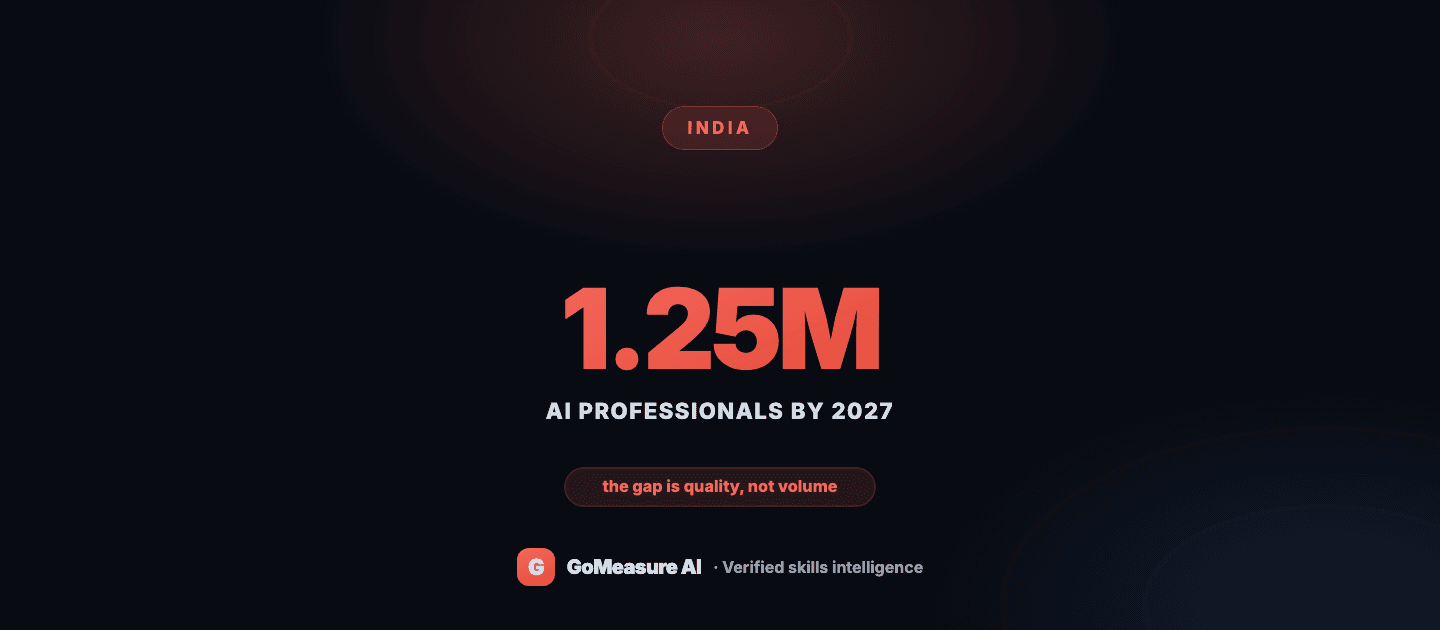
India's AI talent quality gap: volume isn't the problem, verified capability is
India's AI talent challenge is often framed as a shortage of people. The sharper problem is a quality and verification gap: with AI-assisted CVs, courses and portfolios, employers can't reliably tell applied AI capability plus domain judgement from polished signals. Deloitte-Nasscom projects demand above 1.25 million AI professionals by 2027. Here's why the gap is about verified capability — and how to close it with applied projects, role simulations and evidence portfolios.
Read article →
Hiring graduates on potential, not pedigree — the Human Quotient
Companies bet on graduates using the weakest signals they have — a GPA, a college brand, a 20-minute interview — all claims, all biased, and none of them answer the only question that matters for a fresher: what will they become? The Campus Human Quotient battery measures potential and fit instead of knowledge, across Capability (can they think and learn?), Disposition (how are they wired to behave?) and Alignment (will they fit and stay?). Here's why to give it, what to expect from the result, and how to interpret an HQ profile without over-reading it.
Read article →
A test, a role, a person: the three lenses for evaluating talent
You can't evaluate a person from one angle. Zoom all the way in and you see a moment — a single test, precise but a snapshot. Pull back and you see a role — a proven match between a person and a job. Pull back further and you see the whole human — capability, disposition and alignment together. Most talent mistakes are altitude errors: using one lens to answer another's question. The holistic view holds all three on one evidence spine, so they roll up instead of contradicting — and every level traces back to proof.
Read article →
The Human Quotient: what to measure when AI can do the work
As AI commoditises knowing and doing, capability becomes table stakes and the differentiators move up — to judgment, drive and fit. The Human Quotient (HQ) is a measure of the whole working human across three dimensions: Capability (can they perform?), Disposition (how do they behave?) and Alignment (do they fit and stay?). Grounded in the KSAO model and the maximal-vs-typical performance distinction — and built on evidence, not opinion — HQ is the lens the AI era demands, and the fuller model GoMeasure measures toward.
Read article →
Cognitive ability vs. aptitude: what these tests really measure (and what they don't)
Cognitive ability is your general thinking horsepower; an aptitude is that horsepower pointed at one specific thing — your potential to learn it. They blur together because aptitude tests are built out of cognitive-ability components. But neither measures a job skill: they measure the reasoning faculties that predict how fast someone will acquire skills. Put them on a ladder — ability → aptitude → skill → performance — and the confusion clears: the first two are potential, skill is proof, and confusing the rungs is where hiring and promotion go wrong.
Read article →
Inferred, tested, or proven: how to evaluate a skills tool before you buy
Shopping for skills intelligence, everything claims to be "verified" and "data-driven". Underneath, tools do one of three very different things: infer skills from data, test them with a fixed assessment, or prove them by demonstration. Each carries a different level of confidence — and a tool can measure real skills yet still measure the wrong ones. This is how to tell the three apart, the two axes that matter, and the questions to ask any vendor before you buy.
Read article →
Why an off-the-shelf skill assessment tests a role you don't have
Buying a ready-made skills assessment feels like real measurement — and it is. The problem is what it measures. A standard test is built for a standard role, but every company's version of that role has different must-have skills. So the test grades people on a generic set that only partly overlaps with what actually matters — and misses the skills you most needed to check. This is the assessment mismatch, in plain English, and what to do about it.
Read article →
How adaptive interviews actually work: CAT, IRT and evidence-anchored scoring
An adaptive AI interview is not a chatbot with a question list. It is a measurement instrument: computerized adaptive testing chooses each question by information gain, item-response theory estimates true ability with a confidence bound, and every score is anchored to the exact answer that earned it.
Read article →Screening 12,000 graduates in six weeks: a campus hiring case study
A national graduate hiring programme was drowning in 12,000 near-identical applications and a recruiting team that could only phone-screen a fraction of them. This is how adaptive AI interviews turned a six-week bottleneck into an evidence-ranked shortlist — and what the design got right.
Read article →
Verified, inferred, or proven: why the résumé is breaking in the AI era
The résumé was already a weak signal. Generative AI has broken it completely. This is the difference between inferring a skill, testing for it, and proving it — and why only the last one holds up when a hiring decision is challenged.
Read article →