HR strategy & operating model
HR leading the AI-era workforce shift — its own operating model and mandate.
7 articles
The 16 most significant HR struggles in the AI era (2026)
HR's biggest AI-era problem is not training people to use AI. It is determining how jobs are changing, what people can genuinely do with and without AI, where human judgement remains necessary, and whether AI adoption produces measurable value. This report synthesises recent global and India-relevant research (WEF, Deloitte, Microsoft, McKinsey, Gallup, Workday, Deloitte-Nasscom) into the 16 most significant HR struggles — with the required response for each, how they differ by industry, and what HR must change.
Read article →
How AI-era HR problems differ by industry
AI-era HR challenges look similar across sectors, but the capability that matters and the risk of failure are sector-specific: architecture and verification judgement in technology, risk and fraud judgement in BFSI, clinical reasoning in healthcare, shop-floor competence in manufacturing, client judgement in professional services, and more. This guide maps the most acute HR problem, the capability to measure, and the special risk for twelve industries.
Read article →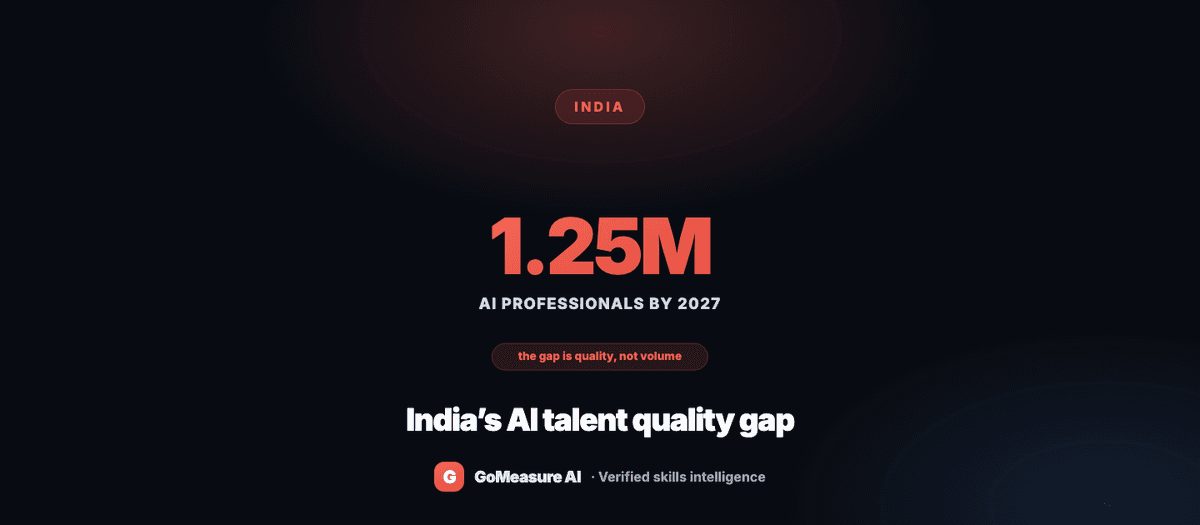
India's AI talent quality gap: volume isn't the problem, verified capability is
India's AI talent challenge is often framed as a shortage of people. The sharper problem is a quality and verification gap: with AI-assisted CVs, courses and portfolios, employers can't reliably tell applied AI capability plus domain judgement from polished signals. Deloitte-Nasscom projects demand above 1.25 million AI professionals by 2027. Here's why the gap is about verified capability — and how to close it with applied projects, role simulations and evidence portfolios.
Read article →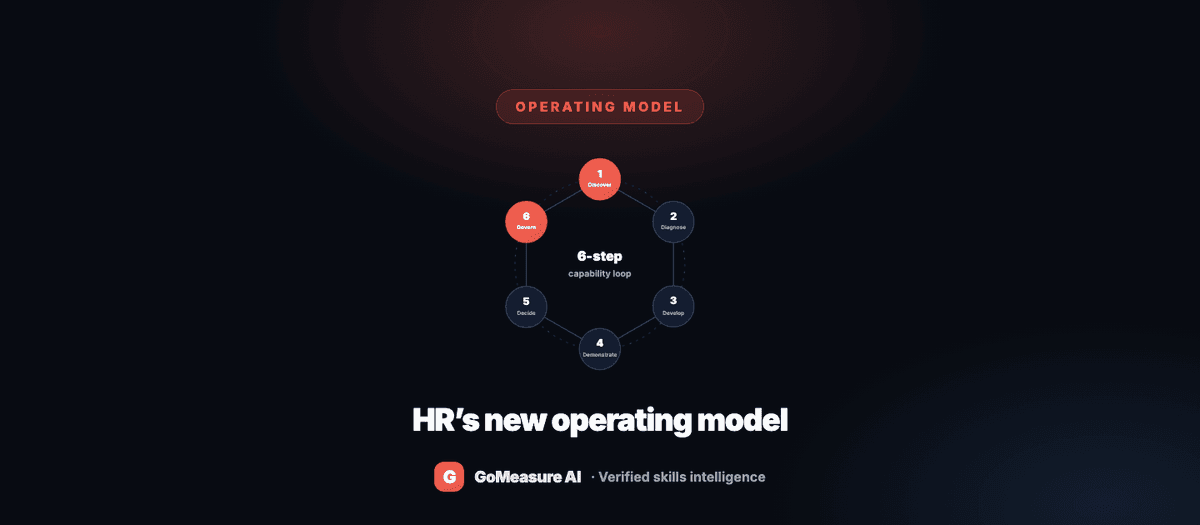
HR's operating model must change: from administrative records to capability intelligence
Every AI-era workforce challenge lands on HR — redesigning work, verifying skills, proving ROI, managing trust — yet Deloitte notes conventional HR is often too slow and siloed for multidisciplinary transformation. This is the case for changing HR's operating model itself: from administrative records and annual programs to continuous capability intelligence, built on a six-step architecture — Discover, Diagnose, Develop, Demonstrate, Decide, Govern.
Read article →
You've set the strategy. Do you have the skills to execute it?
Every system in the HR stack answers a narrower question — who works here, where they are in the pipeline, what they've studied, what they know. But none answers the one executives increasingly ask: do we have the capability to execute our business strategy? Tracing HR technology from HRIS to HRMS to HCM, this is why Skills Intelligence has emerged as its own strategic layer — and what makes it different from a feature bolted onto the systems you already run.
Read article →
From Jobs to Skills: A Practical Framework for Becoming a Skills-Based Organisation
Most organisations intend to become skills-based; very few have. This whitepaper sets out a practical framework for the transformation — a definition, a five-level maturity model, the five stages of the journey, the governance and evidence requirements that make it defensible, a self-assessment you can score today, and where an evidence engine fits.
Read article →
The 2% problem: how a company actually becomes skills-based
Nearly every organisation says it is becoming skills-based. Almost none have arrived. The gap isn't ambition or software — it's that a skills programme built on claims collapses the moment a real decision rests on it. A five-move playbook for transforming on proof, not inventory.
Read article →