This is the operating-model problem behind our 16 significant HR struggles in the AI era. HR is asked to lead transformation while often lacking the three things the job now requires: reliable skills data, AI proficiency, and the authority to redesign work. Deloitte notes that conventional HR, finance and IT functions are often too slow and siloed for the multidisciplinary work AI transformation demands.
Why the old operating model breaks
The six-step measurement architecture
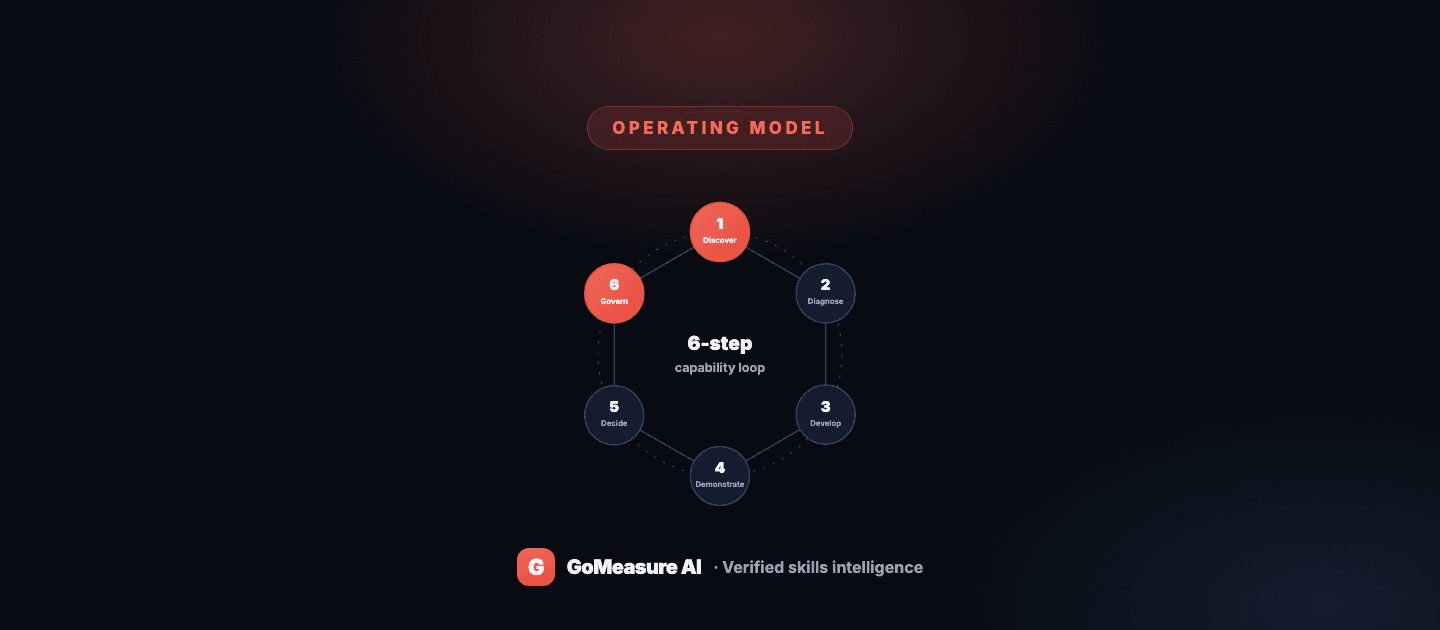
AI-era workforce management runs as a loop, not a calendar event:
- 1. Discover — map roles, tasks, skills and AI exposure. What does the work actually consist of now, and where does AI touch it?
- 2. Diagnose — establish an objective baseline of human and AI-enabled capability, so you know where people really are.
- 3. Develop — prescribe targeted learning, practice and manager support against the specific gaps.
- 4. Demonstrate — capture evidence through simulations, projects and workplace outcomes — proof, not attendance.
- 5. Decide — use verified evidence for hiring, mobility, deployment and succession.
- 6. Govern — maintain identity, auditability, fairness, review and decision accountability throughout.
The shift is from "HR keeps the records" to "HR runs the capability-evidence loop" — continuously, and connected to decisions.
What HR itself needs to build
The operating-model change is also a capability change for HR: stronger AI literacy, a real skills architecture, people-analytics muscle, governance for AI-influenced people decisions, and integration into how the business runs. HR that can do this stops being a downstream administrator and becomes the function that leads transformation with evidence. (See becoming a skills-based organisation and capability as a board-level risk.)
Where GoMeasure fits
GoMeasure is the capability-evidence layer the new operating model runs on. We power the loop end to end — Discover through Govern — baselining and re-verifying human and AI-enabled capability from demonstrated work, connecting learning to proof, and feeding verified evidence into hiring, mobility and succession. And the HR Copilot gives HR teams the operating tools to ask their workforce questions and act on the answers. HR provides the strategy and accountability; GoMeasure provides the continuous evidence underneath it.
Key takeaways
- Every AI-era workforce challenge lands on HR, but static records and periodic programs can't keep pace.
- Deloitte notes conventional HR is often too slow and siloed for multidisciplinary AI transformation.
- The shift is from administrative records to continuous, evidence-based capability intelligence.
- Run it as a six-step loop: Discover, Diagnose, Develop, Demonstrate, Decide, Govern.
- HR must also build its own AI literacy, skills architecture, analytics and governance to lead with evidence.
Frequently asked questions
Why must HR's operating model change for the AI era?
HR is expected to lead AI transformation, but static records and periodic programs can't keep up when important skills change within months. Deloitte notes conventional HR is often too slow and siloed for multidisciplinary transformation.
What is capability intelligence?
A continuous, evidence-based read of what your workforce can actually do — with and without AI — from demonstrated work, kept current and connected to decisions. It replaces annual surveys and administrative records.
What is the six-step measurement architecture?
Discover, Diagnose, Develop, Demonstrate, Decide and Govern — a continuous loop that maps work, baselines capability, develops it, captures evidence, drives decisions, and governs identity, fairness and accountability.
Read the full HR struggles in the AI era report, or talk to us about your operating model.
The whitepaper, the playbooks and new research — by email.
Skills intelligence for HR and business leaders. We'll send the “Jobs to Skills” whitepaper and share new frameworks as we publish them. No noise.
One email now, occasional research later. Unsubscribe anytime.