Reskilling & AI ROI
Reskilling at the speed of change, and proving the return on AI adoption.
4 articles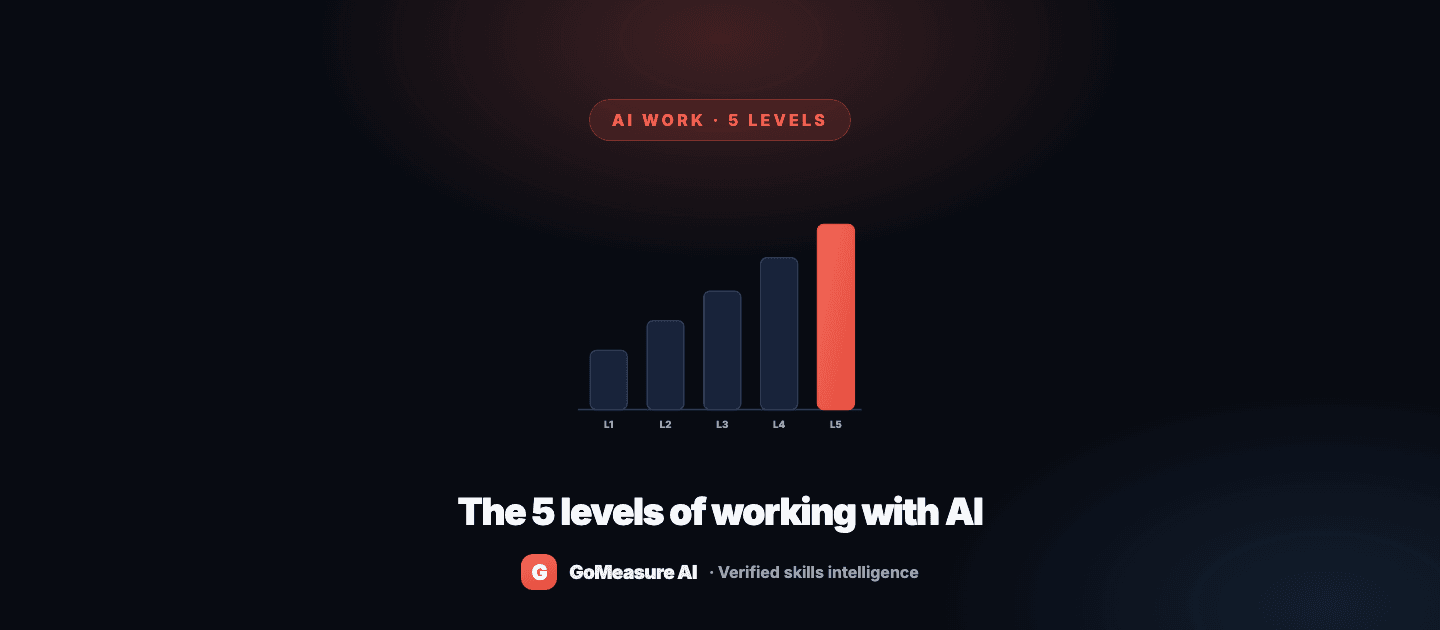
"Working with AI" isn't one skill — the five levels of AI-enabled work
Give two people the same AI tools and one triples their output while the other adds risk. 'Working with AI' is a capability that comes in levels — from basic tool use to designing repeatable AI-enabled operating models. This lays out the five levels of AI-enabled work, and how GoMeasure measures the AI Work Quotient from demonstrated tasks rather than tool familiarity.
Read article →
Proving ROI from AI adoption: why pilots stall — and how to measure real value
Proving ROI is one of the hardest AI-era problems for HR and business leaders — Deloitte finds tech-focused AI approaches are 1.6× more likely to miss ROI expectations than human-centric ones. This is why AI pilots fail to show value, and how to measure it: establish pre-deployment baselines and track adoption, cycle time, work quality, risk and business outcomes — with the human capability underneath verified, not assumed.
Read article →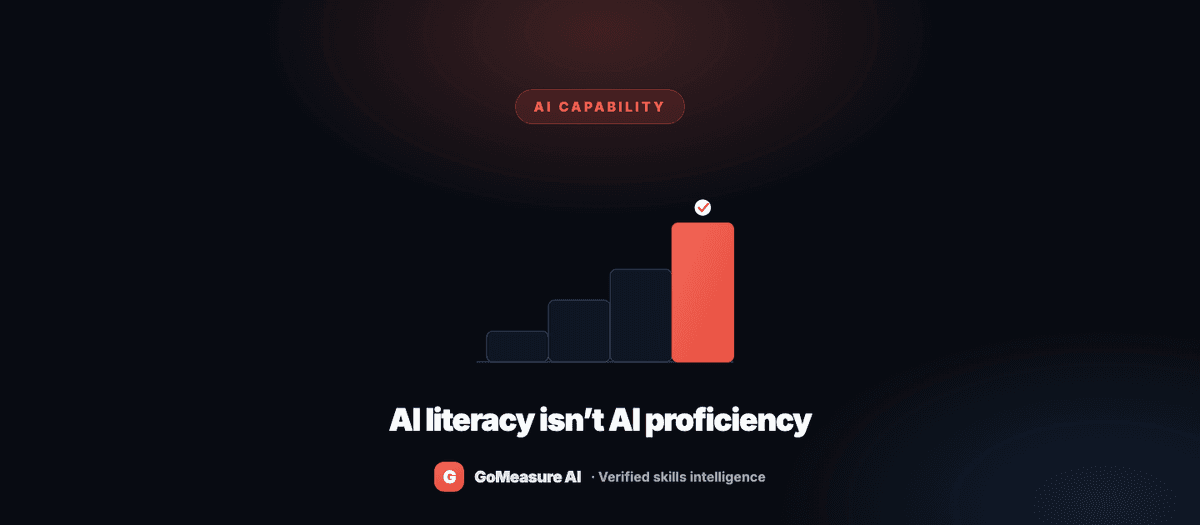
AI literacy isn't AI proficiency: the five levels of AI capability
An 'AI user' is not one person. Microsoft's data shows a wide spread between people who have merely tried AI and those redesigning work around it. This defines the five levels of AI capability — awareness, assisted user, proficient collaborator, workflow designer, AI supervisor — why course completion doesn't prove any of them, and how to measure the level someone is actually at from demonstrated work.
Read article →
How to run a skills gap analysis on one critical role in two weeks
A skills gap analysis is a subtraction: the level a role requires, minus the level your people can actually demonstrate on evidence, equals the gap. This is the two-week pilot we recommend to every HR team that hasn't started — one critical role, its core skills, a gap heatmap of required vs measured with level and confidence — small enough to finish, real enough to change the conversation with leadership.
Read article →