AI-era capability
Can your people actually work with AI — supervise it, verify it, and add value on top?
8 articles
The skill that stops AI hallucinations reaching your customers
A hallucinated number in a client memo, a fabricated citation, a plausible-but-wrong assumption — AI errors are dangerous precisely because they look right. Verification is the capability that catches them before they ship. This explains it, its five levels, and how GoMeasure measures the AI Verification Quotient from demonstrated evidence discipline.
Read article →
If AI wrote it, what did the human add?
AI makes everyone's output look competent, which makes genuine human value harder to see — and easy to over- or under-credit. Human contribution is the capability of adding something the model wouldn't have: reframing, insight, high-value correction, ownership. This explains it, its five levels, and how GoMeasure measures the Human Contribution Quotient to support fairer talent decisions.
Read article →
When should you trust an AI output — and when should you override it?
Two failure modes waste AI: trusting it blindly, and checking everything it produces. The capability that avoids both is trust calibration — knowing when to accept, verify, challenge or override, matched to task risk. This explains calibrated AI trust, its five levels, and how GoMeasure measures the AI Trust Quotient from demonstrated behaviour.
Read article →
AI can draft the answer. Can your people make the call?
When AI can produce a confident recommendation in seconds, the bottleneck moves to judgement: weighing trade-offs, acting when evidence is incomplete, and owning the outcome even when the AI is wrong. This explains judgement as an AI-era capability, its five proficiency levels, and how GoMeasure measures the Judgment Quotient from demonstrated decisions rather than credentials.
Read article →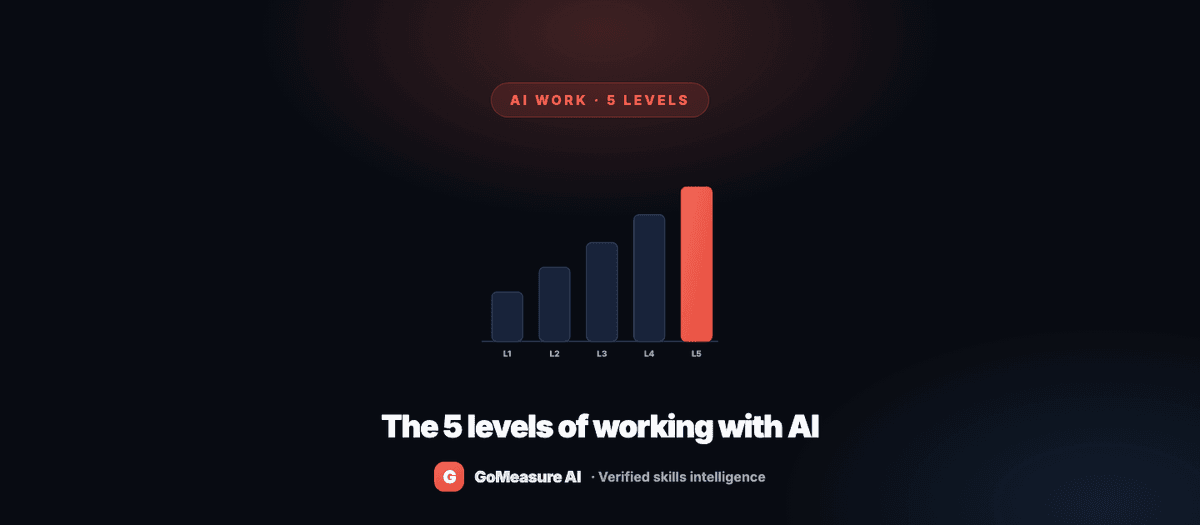
"Working with AI" isn't one skill — the five levels of AI-enabled work
Give two people the same AI tools and one triples their output while the other adds risk. 'Working with AI' is a capability that comes in levels — from basic tool use to designing repeatable AI-enabled operating models. This lays out the five levels of AI-enabled work, and how GoMeasure measures the AI Work Quotient from demonstrated tasks rather than tool familiarity.
Read article →
Can your team actually supervise AI? The oversight capability no one measures
When AI performs significant work, someone still has to supervise, verify, challenge and own the outcome. That capability — AI oversight — is what keeps automation accountable, yet almost no one measures it. This is what AI oversight means, its five proficiency levels, and how GoMeasure measures it (the AI Oversight Quotient) from demonstrated work so you can authorise AI use with confidence.
Read article →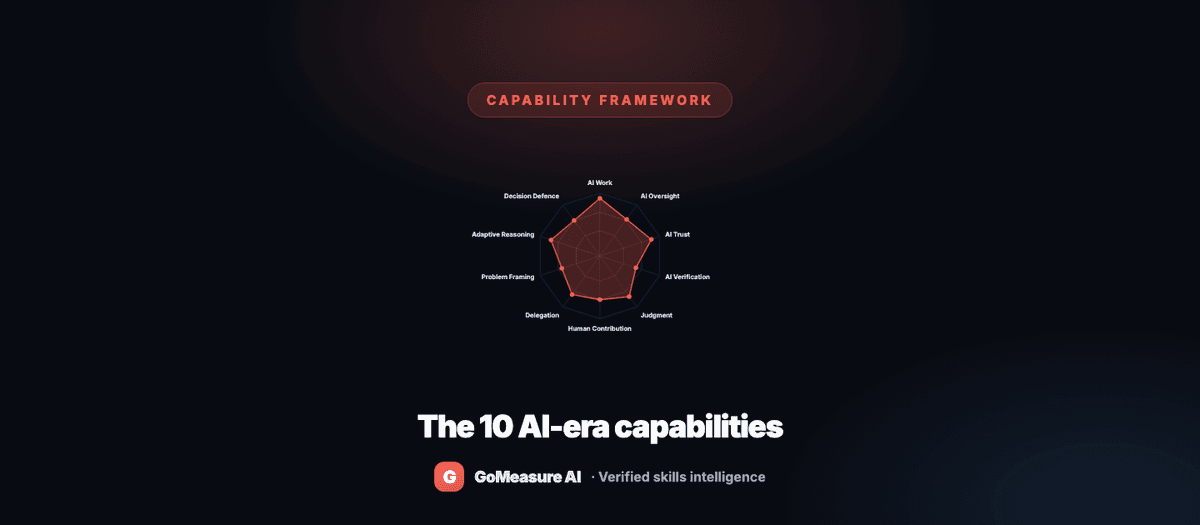
Can your people actually work with AI? The 10 capabilities that decide it
'Can you use AI?' is the wrong question. Real AI-era performance is a set of distinct, measurable capabilities: supervising AI, calibrating trust, verifying output, framing the problem, making and defending the call, and adding value the model can't. This guide lays out GoMeasure's 10-capability framework — each with a five-level rubric — and how organisations can measure them instead of guessing from résumés and tool familiarity.
Read article →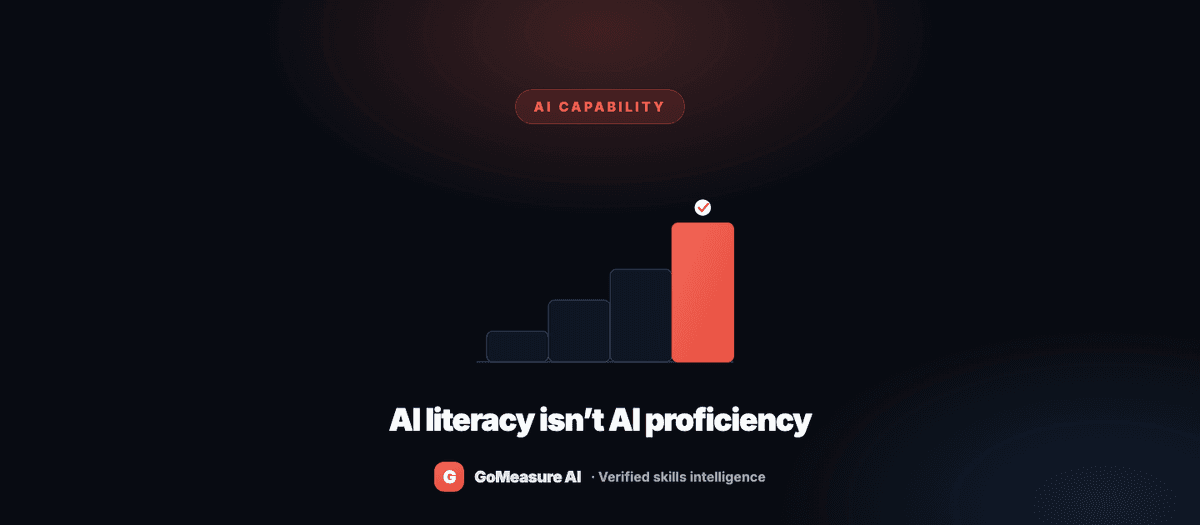
AI literacy isn't AI proficiency: the five levels of AI capability
An 'AI user' is not one person. Microsoft's data shows a wide spread between people who have merely tried AI and those redesigning work around it. This defines the five levels of AI capability — awareness, assisted user, proficient collaborator, workflow designer, AI supervisor — why course completion doesn't prove any of them, and how to measure the level someone is actually at from demonstrated work.
Read article →