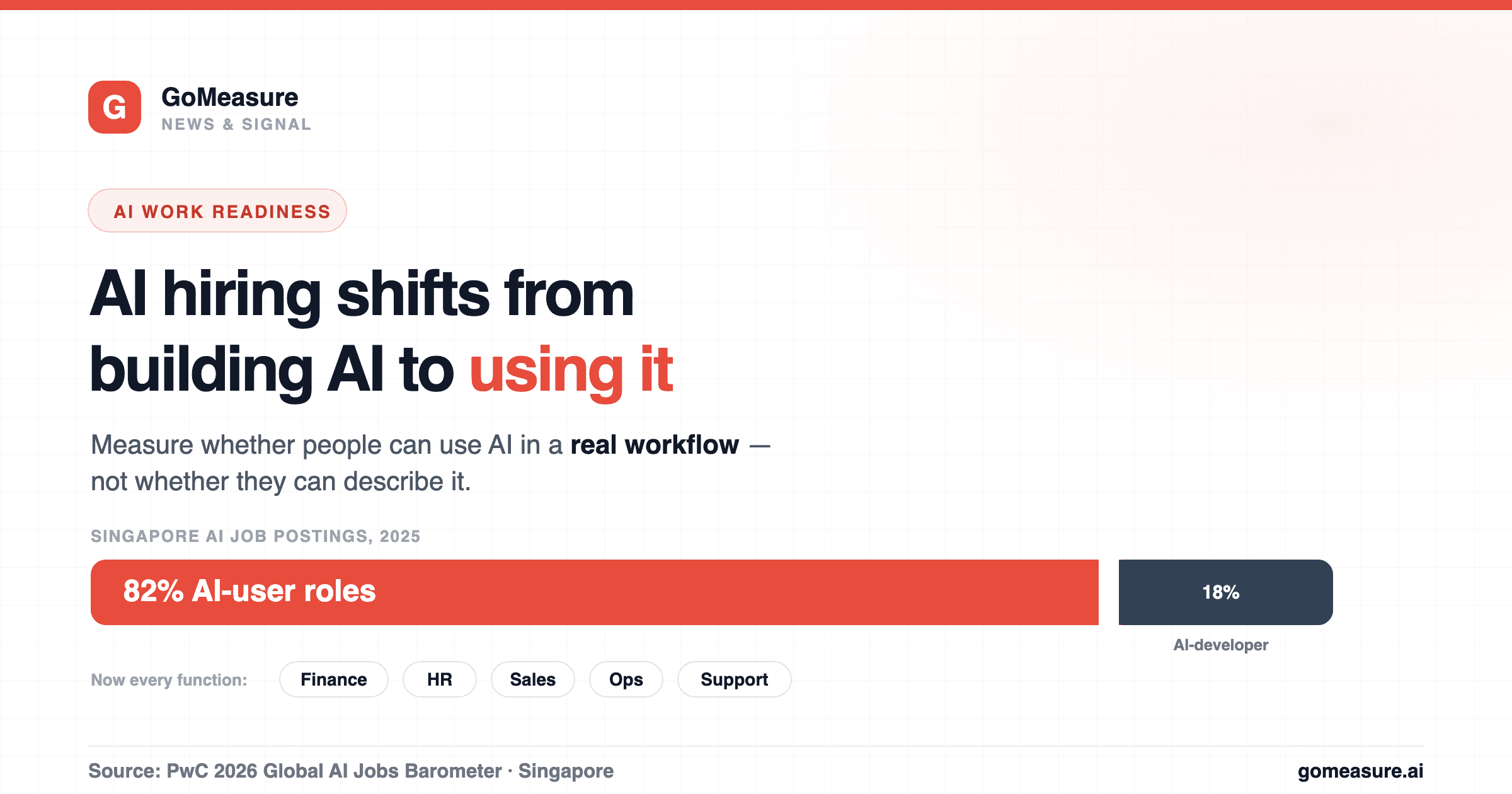
PwC’s 2026 Global AI Jobs Barometer (Singapore edition) shows AI demand shifting decisively from people who build AI to people who use it inside business roles. Of ~84,000 AI-related postings in Singapore in 2025, about 82% were AI-user roles and only ~18% were AI-developer roles — user roles added ~26,000 postings year-on-year, versus ~4,200 for developer roles.
AI-related roles rose to 5.3% of Singapore postings (from 3.3% a year earlier), and the more AI-exposed an occupation, the more its required skill set is changing.
The workforce side agrees: Singapore’s Ministry of Manpower reports that among AI-adopting firms, 18.9% are redesigning roles and 13.9% creating AI roles, while only 6.2% are reducing headcount — and adoption reaches 76.4% among firms with 500+ employees.
This makes AI Work Readiness a distinct product — not another skill category. The question is no longer “does this employee know AI?” but: Role → real workflow → AI task → demonstrated performance → evidence → proficiency → gap → learning → re-verification.
A finance employee shouldn’t be scored on generic prompt-engineering questions — give them a real finance workflow and verify whether they can use AI to analyse data, automate reporting, validate outputs and exercise judgement. It expands the market well beyond developers: finance, HR, sales, operations, marketing, support and management.
GoMeasure measures AI work readiness by role and workflow — who is AI-ready, who is developing, and where the gaps are — using real, role-specific tasks rather than generic prompt quizzes. A finance team is tested on finance work, not trivia.